
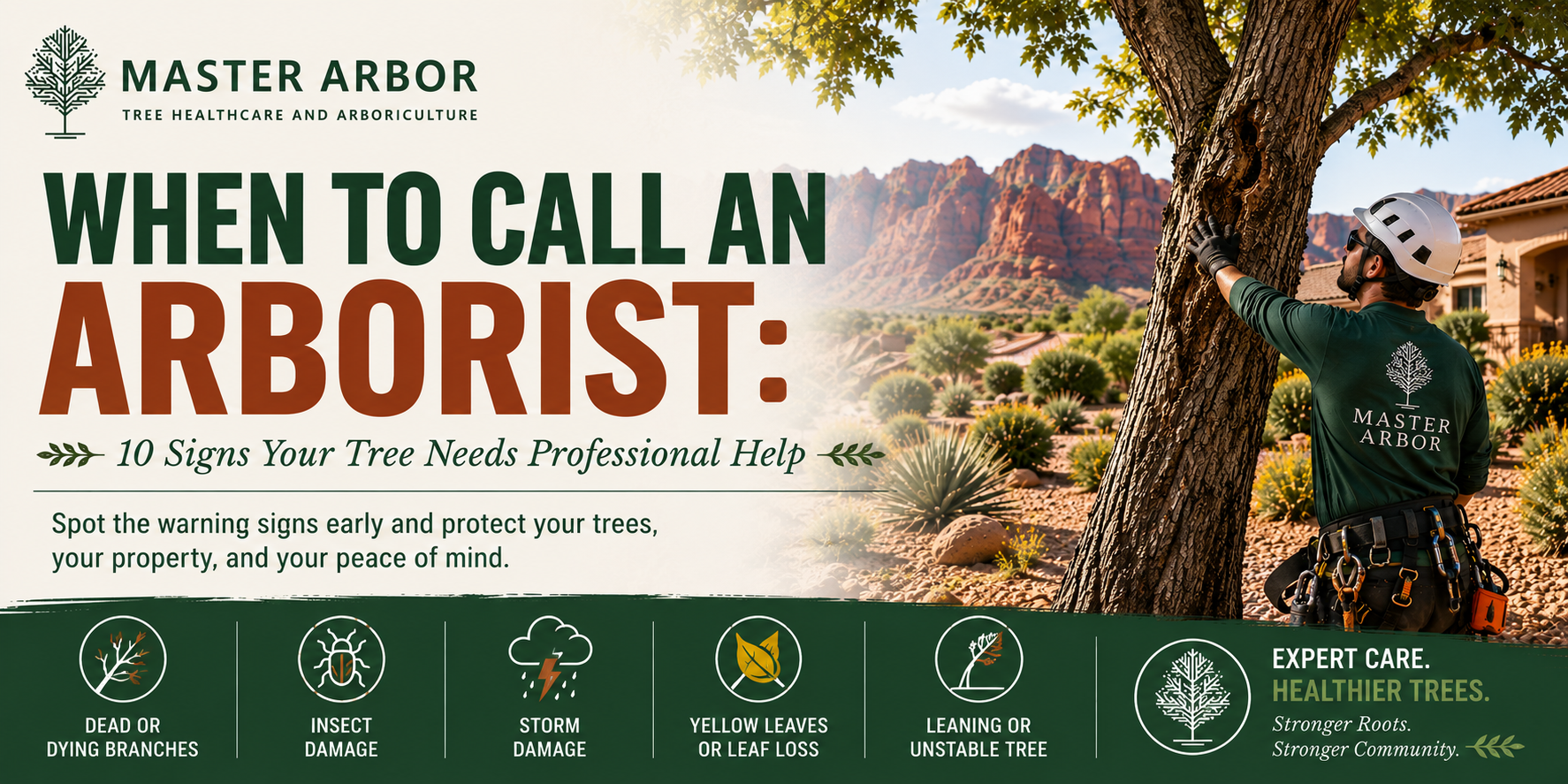
When to Call an Arborist: 10 Signs Your Tree Needs Professional Help
Trees don't always make it obvious when something is wrong.
A few yellow leaves might be normal stress. A dead branch could be relatively minor. But sometimes those same symptoms are the first visible signs of a much larger problem involving the tree's roots, structure, insects, disease, or overall health.
So how do you know when you can monitor a tree yourself—and when it's time to call an arborist?
For homeowners in St. George, Hurricane, Washington City, Santa Clara, Ivins, Silver Reef, and throughout Southern Utah, the answer can be especially tricky. Extreme heat, alkaline soils, drought, irrigation problems, insects, and high winds can all affect trees.
Here are 10 situations when having a professional arborist evaluate your tree is a smart move.
What Does an Arborist Do?
An arborist is a professional who specializes in the care, health, maintenance, and management of trees.
While many people associate arborists with tree trimming or removal, professional tree care goes much further.
An arborist can evaluate:
Branch and trunk structure
Insect activity
Root problems
Watering issues
Nutrient deficiencies
Soil conditions
Heat and drought stress
Storm damage
Potential safety concerns
The goal isn't automatically to remove a struggling tree.
Often, the goal is to determine what's wrong and whether the tree can be preserved.
1. Your Tree Suddenly Starts Losing Leaves
A few leaves falling during summer aren't necessarily alarming.
But if a previously healthy tree suddenly begins dropping significant amounts of foliage, something may have changed.
Possible causes include:
Extreme heat
Underwatering
Overwatering
Root damage
Insects
Soil problems
Transplant stress
In Southern Utah, trees sometimes shed leaves during extreme heat to reduce water loss. But significant or continuing canopy decline deserves a closer look.
Related Article: Why Is My Tree Losing Leaves in Summer? 8 Common Causes in Southern Utah
2. Large Branches Are Dead or Dying
Dead branches aren't just a tree-health issue.
They can also become a property-safety concern.
Large dead limbs can eventually break and fall onto:
Homes
Vehicles
Walls
Walkways
Pools
Landscaping
Watch for branches that:
Have no leaves while surrounding branches are healthy
Have peeling or missing bark
Snap easily
Show extensive decay
Have dead twigs throughout the branch
A professional evaluation can determine why the branch died and whether other areas of the tree are affected.
Proper tree pruning southern utah can remove hazardous deadwood while preserving healthy canopy.
3. The Tree Is Leaning—Especially If the Lean Is New
Some trees naturally grow at an angle.
A new or suddenly increasing lean is different.
Look around the base of the tree for:
Raised soil
Exposed roots
Cracks in the ground
Root movement
A recently shifting trunk
These symptoms can indicate instability.
If a large tree suddenly begins leaning after wind, heavy rain, construction, or root disturbance, have it evaluated promptly.
4. You See Cracks, Cavities, or Damage in the Trunk
The trunk is the structural backbone of a tree.
Not every cavity or crack means a tree is dangerous, but significant trunk defects deserve professional attention.
Look for:
Deep cracks
Large cavities
Splitting
Decayed wood
Loose bark
Open wounds
Sections of missing bark
Young trees can also suffer bark damage from sun scald, lawn equipment, animals, stakes, or other injuries.
The extent and location of the damage matter.
An arborist can determine whether the tree is successfully sealing the wound or whether the damage is compromising its health or structure.
5. Your Tree Has Yellow Leaves and You Don't Know Why
“Why are my leaves turning yellow?” is one of the most common tree-care questions.
Unfortunately, there isn't one answer.
Yellow foliage can be associated with:
Too little water
Too much water
Heat stress
Nutrient availability
Alkaline soil
Root problems
Insects
Normal seasonal changes
Southern Utah's alkaline soils can make certain nutrients less available even when those nutrients are technically present in the soil.
Before adding fertilizer or dramatically increasing irrigation, determine the cause.
Related Article: Why Are My Tree Leaves Turning Yellow? 10 Common Causes in Southern Utah
6. You're Seeing Insects, Webbing, Sticky Leaves, or Bark Holes
Not every insect on a tree is harmful.
In fact, many are harmless or beneficial.
But certain signs should get your attention:
Sticky residue beneath a tree
Fine webbing on foliage
Scale-like bumps on twigs
Distorted leaves
Holes in the trunk or branches
Sawdust-like material
Branch dieback
Common Southern Utah tree pests can include aphids, spider mites, scale insects, and borers.
Correct identification matters because treatments vary dramatically by pest.
Professional tree insect prevention southern utah should focus on identifying the actual problem rather than automatically spraying every insect you see.
7. Your Tree Was Damaged During a Storm
Southern Utah monsoon storms can bring powerful winds, heavy rain, and sudden weather changes.
After a storm, inspect larger trees for:
Broken branches
Hanging limbs
Cracked branch unions
Split trunks
Newly leaning trees
Exposed roots
Canopy damage
Some storm damage is obvious.
Other structural damage can be difficult to see from the ground.
Never attempt to remove large hanging branches near structures, vehicles, power lines, or areas where people are present.
Related Article: Monsoon Season Tree Safety: Preparing for High Winds & Storm Damage
8. Your Tree Looks Scorched Even Though You're Watering It
Brown, crispy leaf edges are extremely common during Southern Utah summers.
But if you're watering regularly and the tree continues to decline, simply adding more water may not solve the problem.
Leaf scorch can result from:
Extreme heat
Dry soil
Damaged roots
Poor water uptake
Reflected heat
Wind
Salt accumulation
Irrigation problems
Rock landscaping, artificial turf, concrete, block walls, and pavers can also increase temperatures around trees.
An arborist can help determine whether the problem is actually insufficient water or whether something else is preventing the tree from using the water it's receiving.
9. Construction or Landscaping Has Disturbed the Root Zone
One of the most overlooked causes of tree decline happens underground.
Construction projects can damage roots during:
Trenching
Pool installation
Patio construction
Retaining-wall installation
Irrigation work
Driveway replacement
Landscape renovations
Soil grading
Heavy equipment can also compact soil around roots.
The frustrating part is that the tree may look fine immediately after the project.
Symptoms can appear weeks or months later.
If you're planning construction around a valuable mature tree, consulting an arborist before work begins can be even more useful than calling after damage occurs.
10. You're Not Sure Whether the Tree Can Be Saved
This may be the most important reason to call an arborist.
Homeowners often wait because they're afraid the answer will automatically be:
“The tree needs to come down.”
That shouldn't be the default conclusion.
Depending on the problem, recommendations might include:
Adjusting irrigation
Corrective pruning
Insect treatment
Soil management
Root-zone care
Monitoring
Structural management
Tree preservation
Sometimes removal really is the safest or most practical option.
But diagnosing the tree first allows you to make that decision based on its actual condition rather than guessing.
When Should You Call an Arborist Immediately?
Some tree problems shouldn't wait for a routine appointment.
Seek professional help promptly if you notice:
A tree suddenly leaning
Large hanging or broken branches
Major trunk splitting
Roots lifting from the ground
Storm-damaged limbs over a home or driveway
Large dead branches over areas people use
Rapid structural changes
If branches are contacting or near electrical lines, stay clear and contact the appropriate utility rather than attempting tree work yourself.
When Can You Monitor the Tree?
Not every unusual leaf means you need an arborist immediately.
You may be able to monitor minor symptoms such as:
A small amount of seasonal leaf drop
Minor leaf scorch after extreme heat
A few yellow leaves
Minor cosmetic insect damage
Temporary transplant stress
Take pictures and compare the tree over several days or weeks.
If symptoms spread, branches begin dying, or the canopy continues thinning, schedule an evaluation.
What Should You Tell the Arborist?
The more information you can provide, the easier it may be to identify what changed.
Before your appointment, think about:
When symptoms started
Whether irrigation recently changed
Recent construction or landscaping
Previous pruning
Recent storms
How quickly symptoms developed
Whether nearby trees show similar symptoms
Any pesticides or fertilizers recently applied
Photos from earlier in the year can also be useful for comparison.
Why Local Tree Knowledge Matters in Southern Utah
Tree problems that occur in Washington County aren't always the same as those seen in cooler parts of Utah.
Our trees regularly contend with:
Triple-digit temperatures
Intense UV exposure
Low humidity
Alkaline soils
Limited rainfall
Irrigation dependence
Reflected landscape heat
Monsoon winds
Desert-adapted insects
That's why effective tree care southern utah requires understanding both the tree and the environment in which it's growing.
Don't Wait Until a Tree Is Beyond Saving
Many tree problems are much easier to address when they're identified early.
A thinning canopy this summer can become major branch dieback next year.
A small insect infestation can spread.
An irrigation problem can slowly weaken roots.
And a structural defect may become much more serious during the next windstorm.
If something about your tree doesn't look right, getting an expert opinion can help you understand whether you have a minor issue, a treatable health problem, or a genuine safety concern.
Worried About a Tree? Let Master Arbor Take a Look.
Master Arbor provides professional tree-health and arboriculture services throughout St. George, Washington City, Hurricane, Santa Clara, Ivins, Silver Reef, and Washington County.
We can help with:
Tree health evaluations
Tree diagnosis
Professional pruning
Insect identification and treatment
Watering recommendations
Heat and drought stress
Root-zone concerns
Storm damage
Structural evaluations
Tree preservation
Tree removal when necessary
Contact Master Arbor today to schedule a tree evaluation and get answers about what's happening with your tree.
Related Articles
Why Is My Tree Losing Leaves in Summer? 8 Common Causes in Southern Utah
Why Are My Tree Leaves Turning Yellow? 10 Common Causes in Southern Utah
Aphids & Spider Mites: Identification, Treatment & Prevention
Monsoon Season Tree Safety: Preparing for High Winds & Storm Damage
Frequently Asked Questions
-
An arborist may evaluate the canopy, branches, trunk, bark, root zone, soil conditions, irrigation, insect activity, structural defects, and environmental stresses to determine the tree's overall condition and recommend appropriate care.
-
Call an arborist when you notice significant canopy thinning, large dead branches, rapid leaf loss, trunk damage, root problems, insect activity, or continuing decline. Early diagnosis may provide more options for preserving the tree.
-
A tree that has always leaned isn't necessarily unstable. However, a new or increasing lean—especially with raised soil, exposed roots, or ground cracking—should be professionally evaluated promptly.
-
Sometimes. Whether a tree can be saved depends on what is causing the decline and how advanced the damage is. Correcting irrigation, managing pests, improving the root zone, or performing appropriate pruning may help some trees recover.
-
If the reason for removal is tree health or safety and the situation is not an immediate emergency, an arborist can help evaluate the tree's condition and determine whether preservation is reasonable or removal is the better option.
