
Storm-Damaged Trees: What to Do After High Winds in Southern Utah
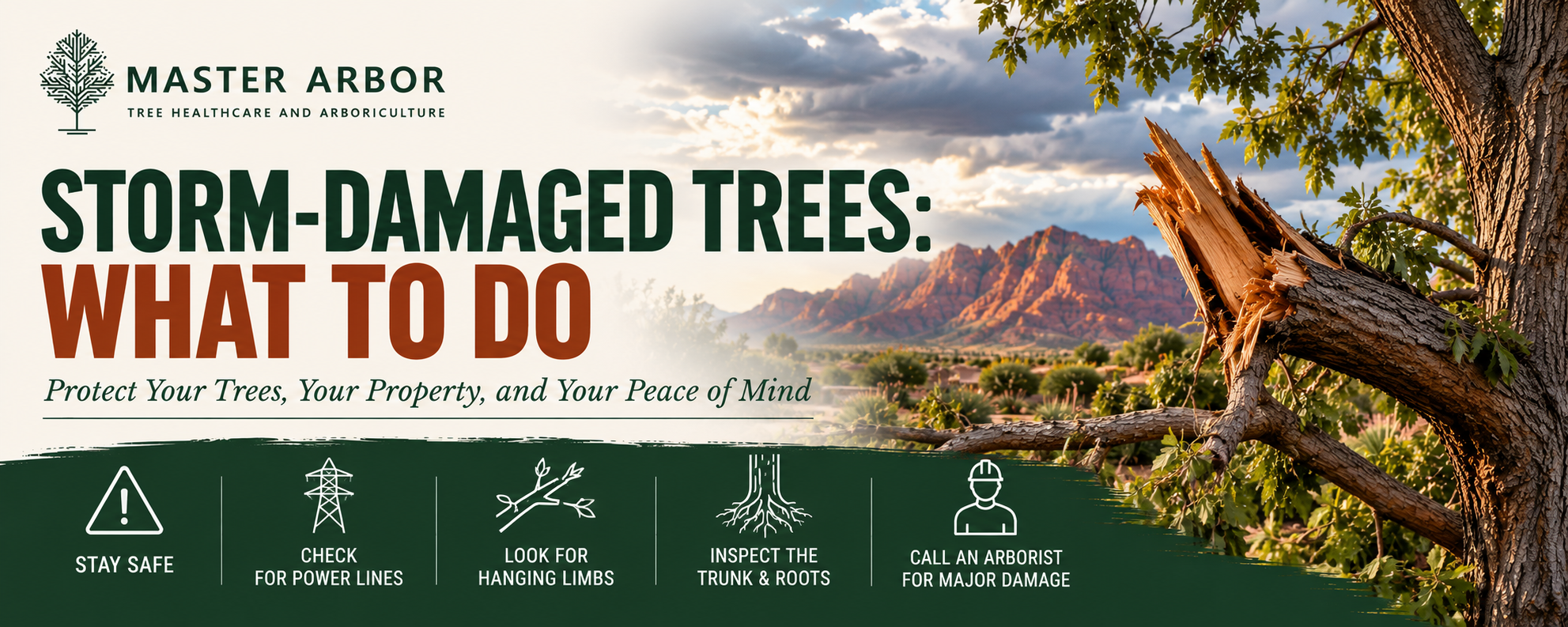
The wind dies down. The storm moves on. Then you walk outside and see branches scattered across the yard—or worse, a large limb hanging from a tree.
What should you do next?
Storm-damaged trees can be deceptive. A broken branch lying on the ground is easy to see, but cracked limbs, weakened branch unions, root movement, and structural damage may be much harder to spot.
In St. George, Hurricane, Washington City, Santa Clara, Ivins, Silver Reef, and throughout Washington County, strong winds and seasonal storms can put already-stressed trees to the test.
If one of your trees has been damaged, don't immediately grab a ladder and chainsaw.
Start here.
First: Keep People Away From the Tree
Before worrying about cleanup, make sure the area is safe.
Stay away from a storm-damaged tree if you see:
Large hanging branches
Split limbs
A cracked trunk
A newly leaning tree
Exposed or lifting roots
Branches resting on structures
Broken branches caught in the canopy
Trees or limbs contacting utility lines
Don't stand beneath damaged limbs to inspect them.
A partially attached branch can fall with little warning, especially if wind continues after the main storm has passed.
If a tree or branch is touching or threatening a power line, stay clear and contact the appropriate utility provider. Do not attempt to remove it yourself.
1. Look at the Tree From a Safe Distance
Once you're sure there isn't an immediate electrical hazard, inspect the tree from the ground.
Walk around it without standing underneath damaged branches.
Look from the ground up, not just at the broken branches.
Check for:
Soil lifting around the base
Newly exposed roots
A change in the tree's lean
Cracks in the trunk
Split trunks
Torn bark
Broken scaffold branches
Hanging limbs
Cracked branch unions
Newly exposed wood
Major canopy loss
Take pictures from several angles.
These can be helpful when discussing the damage with an arborist and can also give you a record of how the tree looked immediately after the storm.
2. Check Whether the Tree Has Started Leaning
A tree that has always grown at an angle isn't necessarily unstable.
A tree that suddenly changes position during a storm is much more concerning.
Look at the soil around the base.
If you notice soil lifting on one side, exposed roots, cracks developing in the ground, or movement around the root plate, the root system may have shifted.
That can be a serious structural concern, particularly with a large tree near a:
House
Driveway
Road
Patio
Pool
Playground
Neighboring property
This is a situation where you should have the tree professionally evaluated rather than waiting to see what happens.
3. Look for Cracked or Hanging Branches
Not every storm-damaged limb falls immediately.
A branch may partially break but remain suspended in the canopy.
These are sometimes called hangers and can be particularly dangerous because they may look relatively stable from the ground.
Watch for:
Branches hanging at unusual angles
Freshly exposed wood
Torn bark
Cracks where branches meet
Limbs resting on other branches
Branches that suddenly droop after the storm
Large hanging limbs should generally be handled by a professional with the proper equipment.
A ladder and chainsaw are a dangerous combination even under normal conditions. Add a partially attached branch under unpredictable tension, and the risk increases significantly.
4. Inspect the Trunk for Splits and Cracks
Branches aren't the only parts of a tree that can fail.
High winds can expose weaknesses in the trunk or major branch unions.
A small superficial bark injury may not threaten the tree, while a deep structural crack can be much more serious.
Pay particular attention to:
Vertical trunk cracks
Splitting between two major stems
Open cavities
Freshly exposed interior wood
Sections of bark pulling away
Movement between co-dominant stems
If the main trunk has split, don't assume the tree automatically needs to be removed—but don't assume it can safely remain either.
An arborist needs to evaluate the location, extent, and structural significance of the damage.
5. Don't Remove More of the Canopy Than Necessary
After a storm, homeowners understandably want the tree to look normal again.
That can lead to over-pruning.
If a tree has already lost a significant amount of foliage during the storm, removing large amounts of additional healthy canopy can add even more stress.
The priority should be:
Remove what is broken, hazardous, or structurally appropriate—not everything that looks uneven.
Good tree pruning southern utah should preserve as much healthy canopy as reasonably possible while addressing damaged branches.
The tree may look asymmetrical temporarily.
That's okay.
Trees need leaves to produce energy for recovery.
6. Don't Top a Storm-Damaged Tree
Storm damage is not a reason to top a tree.
Tree topping involves cutting major limbs back to arbitrary points rather than appropriate branch unions.
Although it may make a damaged tree look smaller, topping can create additional problems, including:
Large pruning wounds
Increased decay potential
Excessive sprout growth
Weakly attached new branches
Loss of valuable canopy
Long-term structural problems
A damaged tree needs thoughtful corrective pruning, not drastic cutting.
7. Can a Storm-Damaged Tree Be Saved?
Often, yes.
A broken branch does not automatically mean a tree should be removed.
An arborist will consider several factors.
How much canopy was lost?
A tree that lost one branch is very different from a tree that lost half of its major canopy.
Was the trunk damaged?
Damage to the main trunk or major structural unions can be more significant than smaller branch loss.
Are the roots stable?
Root movement can dramatically change the assessment.
Is the remaining structure sound?
A tree may still have a healthy canopy but be structurally compromised.
What condition was the tree in before the storm?
Decay, previous topping, poor branch structure, root damage, or chronic stress may have contributed to the failure.
The important question isn't simply:
“Can this tree stay standing today?”
It's also:
“What does this damage mean for the tree's future health and structure?”
8. Don't Paint or Seal Broken Branches
Homeowners sometimes assume that exposed wood needs to be covered with pruning paint, tar, or wound sealer.
For most ordinary tree wounds, that isn't necessary.
Trees don't heal wounds the way human skin does. Instead, they compartmentalize damaged tissue and gradually grow new tissue around the injury.
The more important step is making appropriate pruning cuts when damaged branches need to be removed.
Avoid applying household products or improvised sealants unless a qualified professional recommends a treatment for a specific reason.
9. Help the Tree Recover After the Storm
Once immediate hazards and damaged branches have been addressed, focus on reducing additional stress.
Check irrigation.
A storm doesn't necessarily mean your tree received enough water.
Short, intense Southern Utah storms may produce considerable runoff without deeply wetting the root zone.
Avoid unnecessary fertilizer.
A damaged tree doesn't automatically need fertilizer. Excessive fertilization can stimulate growth when the tree needs to focus its resources elsewhere.
Protect the root zone.
Avoid driving, parking, storing heavy materials, or compacting soil around the tree.
Watch newly exposed bark.
If a storm removes significant canopy, branches or trunk tissue that was previously shaded may suddenly receive intense Southern Utah sunlight.
That can increase the potential for sun injury.
Monitor the tree.
Storm damage can evolve over time.
Watch for leaf loss, wilting, branch dieback, cracks, insect activity, or additional structural changes in the weeks following the storm.
10. Watch for Problems That Appear Later
Not every consequence of storm damage appears the next morning.
A damaged tree may look reasonably healthy initially and begin showing symptoms later.
Watch for:
Increasing canopy thinning
Dead branch tips
Yellow leaves
Premature leaf drop
Bark separating around an injury
Insect activity
Fungal growth
Expanding cracks
Additional limb failure
Trees already stressed by Southern Utah's extreme heat and drought may have fewer resources available for recovery.
Professional tree insect prevention southern utah can also become important because stressed or damaged trees may be more susceptible to certain pests.
Storm Damage or an Existing Tree Problem?
Sometimes a storm doesn't actually create the underlying weakness.
It reveals it.
A branch that fails during high winds may already have had:
Internal decay
Poor branch attachment
Included bark
Previous improper pruning
Deadwood
Root damage
Structural defects
That's one reason inspecting the entire tree after significant storm damage is important.
The branch on the ground may only be part of the story.
When Should You Call an Arborist After a Storm?
You should strongly consider a professional inspection when:
A large branch has failed
Branches are hanging in the canopy
The trunk has cracked or split
The tree has developed a new lean
Roots or soil have lifted
Significant portions of the canopy were lost
Damage occurred over a home or frequently used area
You're unsure whether the remaining tree is structurally sound
Even when removal isn't necessary, an arborist may recommend corrective pruning, monitoring, or other steps to help preserve the tree.
For more guidance, read When to Call an Arborist: 10 Signs Your Tree Needs Professional Help.
Before the Next Southern Utah Storm
Once damaged trees have been addressed, take a look at the rest of your property.
Preventive tree care can't guarantee that a tree will never fail during extreme weather, but identifying obvious problems beforehand can reduce risk.
Consider having trees evaluated for:
Deadwood
Weak branch attachments
Cracks
Poor structure
Previous topping damage
Overextended branches
Root problems
Significant decline
Appropriate pruning may help improve tree structure without unnecessarily stripping the canopy.
Our Monsoon Season Tree Safety: Preparing for High Winds & Storm Damage guide explains what homeowners can do before severe weather arrives.
Storm-Damaged Tree? Don't Guess About Its Safety.
A tree can survive surprisingly significant storm damage.
It can also remain standing while having serious structural problems that aren't obvious from the ground.
That's why the goal after a storm shouldn't be to simply clean up the mess.
It's to determine:
What broke? Why did it break? What's still damaged? And is the remaining tree healthy and structurally appropriate to retain?
Master Arbor provides professional tree evaluations and storm-damage services throughout St. George, Washington City, Hurricane, Santa Clara, Ivins, Silver Reef, and Washington County.
Need Help After a Storm?
Master Arbor can help with:
Storm-damage evaluations
Broken and hanging branch removal
Tree health evaluations
Corrective pruning
Structural assessments
Hazardous tree evaluation
Tree preservation
Tree removal when necessary
Contact Master Arbor today to have your storm-damaged trees evaluated before hidden damage becomes a bigger problem.
Frequently Asked Questions
-
Yes. Many trees can recover from broken branches and moderate canopy loss if the trunk, roots, and remaining structure are healthy. Severe trunk splitting, root movement, or extensive structural damage may significantly affect whether the tree can safely remain.
-
Small, safely accessible branches may sometimes be appropriate for homeowners to address, but large, hanging, elevated, or tensioned branches should be handled professionally. Never attempt tree work near utility lines.
-
Not necessarily. A tree that has always leaned may be stable. A new or increasing lean after a storm—especially with lifting soil or root movement—requires prompt professional evaluation.
-
Not automatically. Fertilizer does not repair structural damage and may not benefit a stressed tree. Address damaged branches, roots, irrigation, and other underlying issues before assuming fertilizer is necessary.
-
Call an arborist when there are large broken or hanging branches, trunk cracks, significant canopy loss, a new lean, root movement, or uncertainty about the tree's structural condition.
