
How to Water Desert Trees: How Often? How Much?

Desert trees are built to handle heat and dry conditions—but that doesn't mean they don't need water.
In fact, one of the most common problems we see with trees throughout St. George, Hurricane, Washington City, Santa Clara, Ivins, Silver Reef, and Washington County isn't necessarily too little water.
It's watering incorrectly.
Some trees receive a little water every day but never enough to reach their deeper roots. Others are soaked so frequently that the soil stays wet and roots struggle to get enough oxygen.
So, how often should you water a desert tree? And how much water should you give it?
The answer depends on the tree's age, size, species, soil, season, and irrigation system.
Here's how to get it right in Southern Utah.
Desert Trees Need Deep Water, Not Constant Water
The goal of watering a tree isn't to keep the surface of the soil wet.
You want moisture to penetrate into the tree's active root zone.
Frequent, shallow watering tends to wet only the upper portion of the soil. In Southern Utah's summer heat, that moisture can disappear quickly.
Deep watering encourages roots to explore a larger volume of soil and makes established trees more resilient between irrigation cycles.
That's why one of the most important principles of tree care southern utah is:
Water deeply, then allow the soil to begin drying before watering deeply again.
How Often Should You Water Desert Trees?
There isn't one schedule that works for every tree.
A newly planted desert willow and a 20-year-old mesquite have completely different root systems.
As a starting point, think about trees in three stages.
Newly Planted Trees: 0–3 Months
New trees need the most attention because nearly all of their roots are still concentrated within the original root ball.
During hot weather, they may need water several times per week.
The goal is to keep the root ball from completely drying out without leaving it constantly saturated.
Check the soil frequently because container-grown root balls can dry much faster than the surrounding landscape soil.
During Southern Utah's hottest weather:
A newly planted tree may initially require watering approximately 2–4 times per week, depending on:
Tree size
Species
Soil
Drainage
Sun exposure
Wind
Irrigation output
Don't use the calendar alone. Check the soil.
Our guide on How Often to Water New Trees in Southern Utah goes deeper into establishing newly planted trees.
Establishing Trees: About 3 Months–2 Years
As roots begin growing beyond the original planting hole, watering should gradually become:
Less frequent + deeper + wider.
Instead of concentrating all irrigation beside the trunk, expand the watering area as the root system develops.
During summer, many establishing trees may need deep watering roughly every 3–7 days, depending heavily on the species, soil, weather, and irrigation output.
The goal is to encourage roots to spread outward rather than keeping them dependent on a tiny wet zone.
Established Desert Trees
Once properly established, drought-tolerant trees should generally be watered much less frequently.
During extreme summer heat, many established desert-adapted trees may benefit from a deep watering approximately every 7–21 days, but this is intentionally a broad range.
Why?
Because a desert willow, palo verde, mesquite, Chinese pistache, and mature olive do not all have identical water requirements.
Native and highly drought-adapted species may tolerate longer intervals, while other landscape trees require more consistent supplemental irrigation.
During cooler seasons, irrigation frequency can usually be reduced significantly.
A Southern Utah Desert Tree Watering Guide
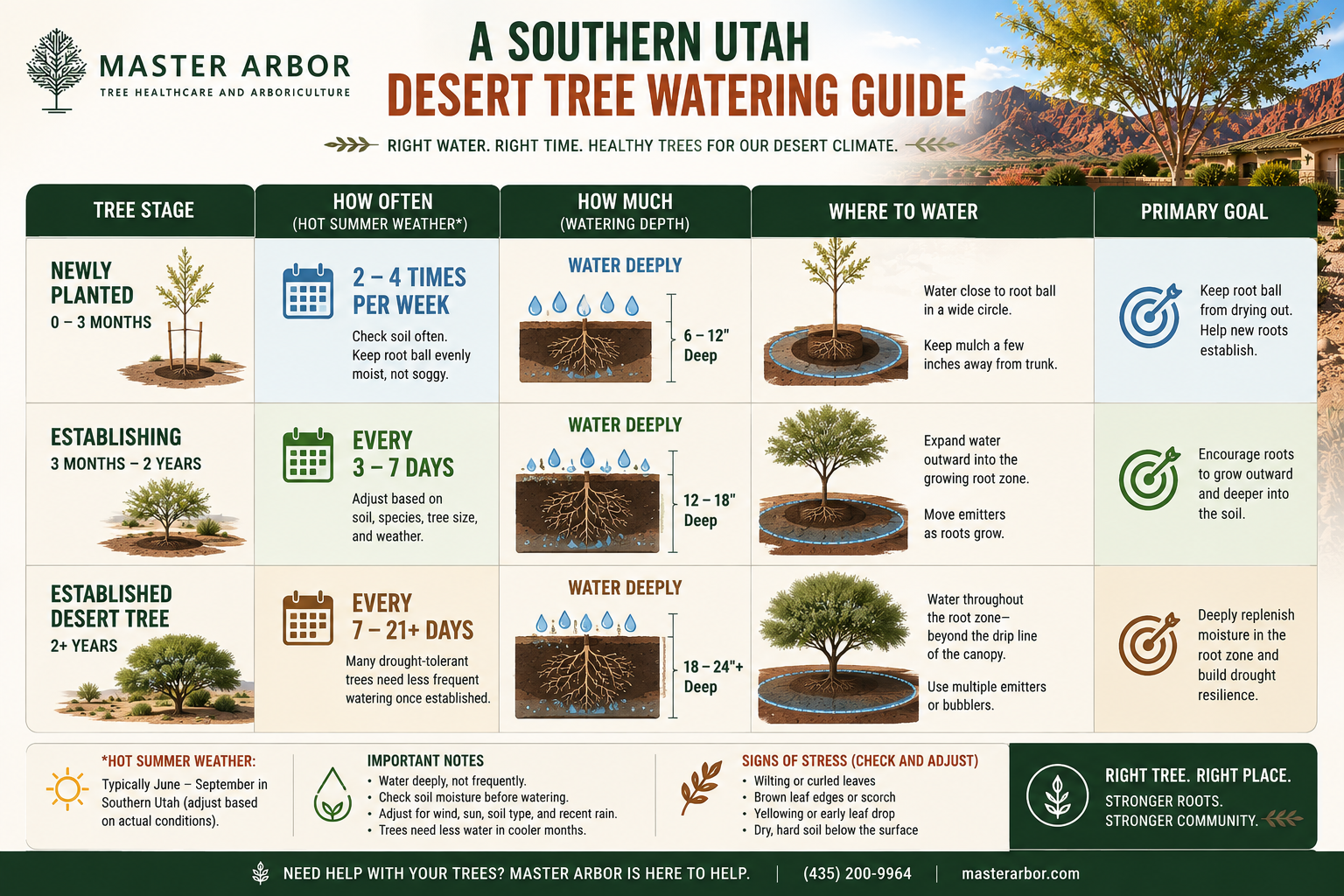
These are starting ranges—not fixed schedules. Soil type, species, tree size, exposure, rainfall, irrigation output, and actual soil moisture should determine when you water.
How Much Water Does a Desert Tree Need?
This is where watering advice often gets confusing.
Saying “water for 30 minutes” doesn't tell you how much water the tree actually received.
One irrigation system might deliver 5 gallons in that time.
Another might deliver 50.
Instead of focusing only on minutes, focus on two things:
1. How much water is being delivered?
Know the approximate output of your emitters or irrigation system.
2. How deeply is that water penetrating?
For established trees, the goal is generally to wet the soil deeply through a meaningful portion of the root zone—not merely the top few inches.
A practical target is often 12–18 inches deep, with some tree and soil conditions benefiting from moisture reaching deeper.
You can check this after watering with a long screwdriver, soil probe, or by carefully digging a small test hole.
If the soil is wet only two or three inches deep, your tree probably isn't receiving a true deep watering.
Don't Water Only at the Trunk
This is one of the most important changes homeowners can make.
A tree's absorbing roots aren't all clustered against the trunk.
As a tree grows, roots spread outward—often well beyond the canopy.
For established trees, irrigation should generally be distributed throughout the root zone, particularly beneath and around the canopy and beyond the drip line where active absorbing roots are present.
Think:
Wide and deep—not narrow and shallow.
Keeping the trunk constantly wet can also encourage unnecessary moisture around the root flare.
Drip Irrigation: How Many Emitters Does a Tree Need?
One tiny drip emitter next to the trunk may have worked when the tree was newly planted.
Five years later, it probably isn't enough.
As the tree grows:
Add emitters as necessary.
Move irrigation outward.
Increase the total watered area.
Verify emitter output.
Check for clogged emitters.
Make sure water actually penetrates deeply.
The irrigation system should grow with the tree.
This is one of the most commonly overlooked issues we see in established landscapes.
The tree gets larger every year while its irrigation footprint stays exactly the same.
Eventually, those two things no longer match.
How Soil Type Changes Your Watering Schedule
Southern Utah soils aren't identical from property to property.
Sandy or Fast-Draining Soil
Water moves through these soils relatively quickly.
Trees may need:
Somewhat more frequent watering
Careful monitoring during extreme heat
Clay or Slow-Draining Soil
Water moves much more slowly.
These soils may require:
Longer intervals between watering
Slower application
Care to avoid saturation
If water runs off instead of soaking in, try cycle-and-soak watering: apply water slowly, pause, then resume.
That gives the soil time to absorb moisture rather than allowing it to run across the landscape.
Rock Landscaping Can Be Deceptive
Decorative rock is common throughout Southern Utah.
While it creates an attractive low-water landscape, rock can make the tree's environment significantly hotter.
Rock absorbs solar energy throughout the day and can radiate heat around the root zone and lower canopy.
Trees surrounded by:
Dark decorative rock
Artificial turf
Concrete
Pavers
Block walls
may experience more heat stress than trees surrounded by organic mulch or vegetation.
That doesn't automatically mean you should water more frequently.
It means you should monitor soil moisture and tree stress more carefully.
How Can You Tell When a Tree Needs Water?
Instead of relying exclusively on an irrigation timer, learn to read both the tree and the soil.
Possible signs of insufficient water include:
Wilting
Curling leaves
Brown leaf margins
Leaf scorch
Premature leaf drop
Dry soil in the root zone
Canopy thinning
However, don't immediately assume that every wilted or yellow tree needs more water.
Signs You May Be Overwatering
Overwatered trees can look surprisingly similar to underwatered trees.
Watch for:
Yellowing leaves
Premature leaf drop
Weak growth
Persistently wet soil
Soft or declining roots
Dieback
Fungal activity in consistently wet areas
Roots need water and oxygen.
When soil remains saturated, root function can decline, which may cause the canopy to look thirsty even though water is everywhere.
Before increasing irrigation, check the soil.
What Time of Day Should You Water Trees?
In Southern Utah, early morning is generally an excellent time for irrigation.
Temperatures are cooler, evaporation is lower, and water has time to penetrate the soil before the hottest part of the day.
Avoid relying on brief midday watering to rescue chronically dry soil.
A proper watering strategy should maintain adequate moisture in the root zone before severe stress develops.
Should I Water After a Monsoon Storm?
Maybe—but don't assume a summer storm replaced your scheduled deep watering.
Southern Utah monsoon storms can dump substantial rain in one neighborhood while barely wetting the ground a few miles away.
Some storms are also intense but brief, causing much of the water to run off.
Check the soil before deciding.
If moisture penetrated deeply into the root zone, delay your next irrigation.
If only the surface is wet, the tree may still need supplemental water.
What About Drought-Tolerant Trees?
Drought-tolerant trees still need water.
Species such as:
Desert willow
Desert Museum palo verde
Mesquite
Texas mountain laurel
Arizona cypress
Fruitless olive
can tolerate dry conditions much better after they're established.
But a newly planted palo verde is still a newly planted tree.
Its roots haven't yet spread into the surrounding soil.
If you're planning your landscape, read our Best Drought-Tolerant Trees for Southern Utah: 10 Trees Built for the Desert before choosing your next tree.
Three Watering Mistakes We See Again and Again
Mistake #1: Watering every day for a few minutes
This can create shallow moisture without adequately watering deeper roots.
Mistake #2: Never changing the irrigation system
Trees grow. Their irrigation footprint should grow with them.
Mistake #3: Treating every tree the same
Species, age, size, soil, and location all affect water requirements.
A mature mesquite shouldn't necessarily be watered like a newly planted Chinese pistache.
The Best Watering Schedule Is Based on the Soil
If there's one thing to remember from this guide, make it this:
Don't water a tree simply because the timer says it's Tuesday.
Check what's happening underground.
If the root zone is still adequately moist, the tree may not need more water yet.
If it's dry much sooner than expected, determine why.
A watering schedule should respond to:
Tree + soil + weather + season.
That's far more effective than following the same irrigation schedule from January through August.
Not Sure If Your Tree Is Getting Enough Water?
Sometimes the symptoms aren't straightforward.
Yellow leaves might be caused by overwatering, underwatering, alkaline soil, root damage, insects, or heat stress.
Leaf drop can be a tree's response to drought—or a symptom of root problems.
Master Arbor can help determine what's actually happening before you start changing irrigation or applying unnecessary treatments.
We provide professional tree-health services throughout St. George, Washington City, Hurricane, Santa Clara, Ivins, Silver Reef, and Washington County.
Get a Professional Tree Health Evaluation
Master Arbor can help with:
Watering and irrigation recommendations
Drought and heat-stress diagnosis
Root-zone evaluations
Soil concerns
Young-tree care
Tree preservation
Contact Master Arbor today to schedule a tree-health consultation and make sure your trees are getting the right amount of water—not simply more water.
Related Articles
Best Drought-Tolerant Trees for Southern Utah: 10 Trees Built for the Desert
Why Is My Tree Losing Leaves in Summer? 8 Common Causes in Southern Utah
Frequently Asked Questions
-
Newly planted trees may need water several times per week during hot weather, while established drought-tolerant trees may go one to several weeks between deep waterings. Species, soil, tree size, weather, and soil moisture should determine the actual schedule.
-
For established trees, aim to wet a meaningful portion of the root zone rather than just the surface. Moisture reaching approximately 12–18 inches deep is a useful general target, although soil and tree conditions vary.
-
Check soil moisture below the surface after irrigation. If only the upper few inches are wet, irrigation may be too shallow. You can use a soil probe, screwdriver, or small test hole to evaluate moisture depth.
-
Yes. Constantly saturated soil reduces oxygen around roots and can cause yellowing, leaf loss, poor growth, root decline, and other problems.
-
Not exclusively. As a tree grows, its irrigation area should expand outward into the developing root zone. An irrigation setup designed for a newly planted tree may be inadequate several years later.
