
Warning Signs a Tree Is Dangerous: 10 Signs You Shouldn’t Ignore
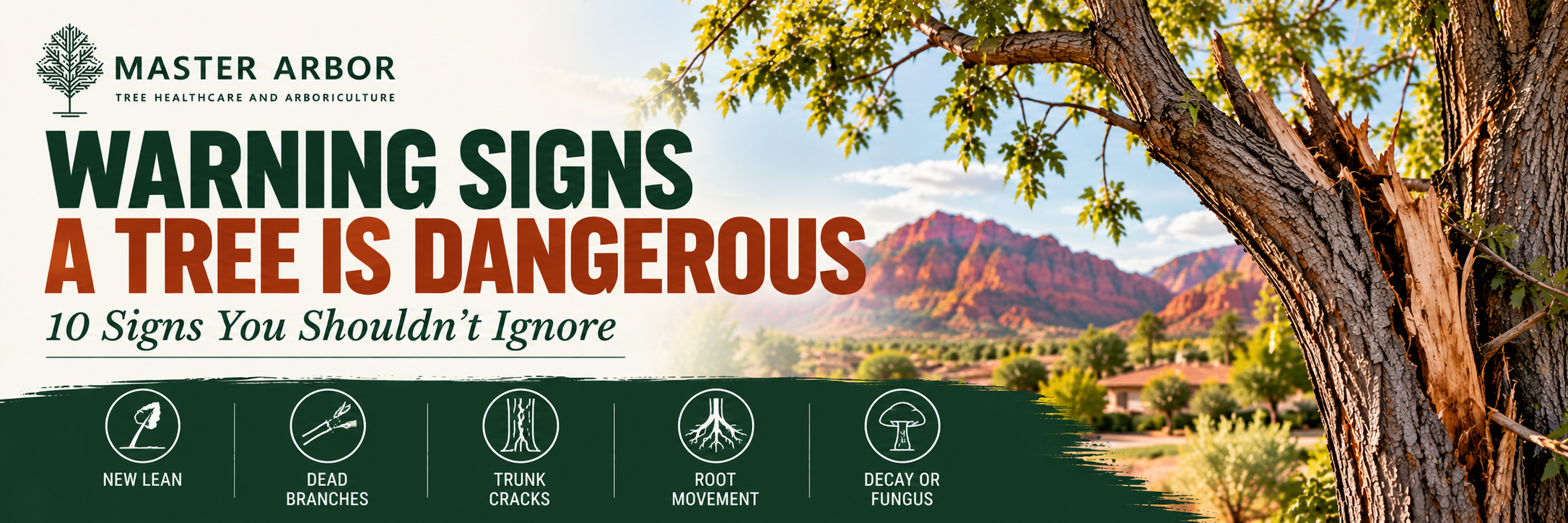
Most trees don't suddenly become dangerous overnight. Before a major limb breaks or an entire tree fails, there are often warning signs—if you know what to look for.
A crack where two trunks meet. Soil lifting around the roots. A large dead branch hanging over the driveway. Mushrooms growing near the base. A tree that seems to be leaning a little more than it did last year. None of these automatically means a tree is about to fall. But they are reasons to take a closer look.
That's particularly important in Southern Utah, where trees in St. George, Washington City, Hurricane, Santa Clara, Ivins, Silver Reef, and throughout Washington County contend with extreme heat, drought stress, irrigation challenges, and periods of strong wind.
Here are 10 warning signs that a tree may pose a safety concern—and when it's time to call an arborist.
1. The Tree Has Developed a New Lean
Some perfectly healthy trees naturally grow at an angle. The key word here is new. If a previously upright tree begins leaning—or an existing lean suddenly becomes more pronounced—it may indicate movement in the root system.
Look around the base for:
Soil lifting on one side
Cracks in the ground
Newly exposed roots
A raised root plate
Gaps forming between the trunk and soil
A newly leaning tree following a windstorm deserves particular attention. If the tree is large enough to reach a home, road, driveway, neighboring property, or frequently used area, have it professionally evaluated promptly.
2. There Are Large Dead Branches in the Canopy
A dead twig isn't the same thing as a large dead limb. Large dead branches can eventually break from the tree, particularly during high winds.
Warning signs include:
No foliage while nearby branches are healthy
Missing or peeling bark
Brittle twigs
Dead branch tips
Visible decay
Large bare sections of the canopy
Pay particular attention to deadwood over:
Houses
Driveways
Sidewalks
Patios
Pools
Play areas
Parking areas
Professional tree pruning southern utah can address hazardous deadwood without unnecessarily removing healthy portions of the canopy.
3. You See a Large Crack in the Trunk
Not every crack makes a tree dangerous. However, significant cracks in the trunk or major limbs can indicate structural weakness.
Look for:
Deep vertical cracks
Splitting between two trunks
Freshly exposed wood
Cracks extending into major branch unions
Sections of the trunk visibly separating
A crack becomes more concerning when it affects a major structural portion of the tree. If you can see movement in the crack during wind, keep people away from the area and have the tree evaluated.
4. Two Large Trunks Are Splitting Apart
Trees with multiple trunks aren't automatically unsafe. But certain unions between stems can be weaker than others. A narrow V-shaped union may develop included bark—bark that becomes trapped between two stems instead of forming a strong wood connection. As both trunks become larger and heavier, the union can become more susceptible to splitting.
Look for:
Very narrow attachment angles
Bark compressed between trunks
A visible seam extending down the union
Cracking between stems
One stem beginning to pull away
This is also why structural pruning while trees are young can be so valuable. Correcting poor structure early may reduce much larger problems later.
5. The Roots or Soil Are Moving
Some of the most important warning signs aren't in the canopy. They're at ground level. A tree depends on its root system for both water uptake and structural support.
Watch for:
Soil heaving around the trunk
Roots lifting from the ground
Cracks developing through the root zone
Sudden changes around the base after high winds
A root plate that appears to be shifting
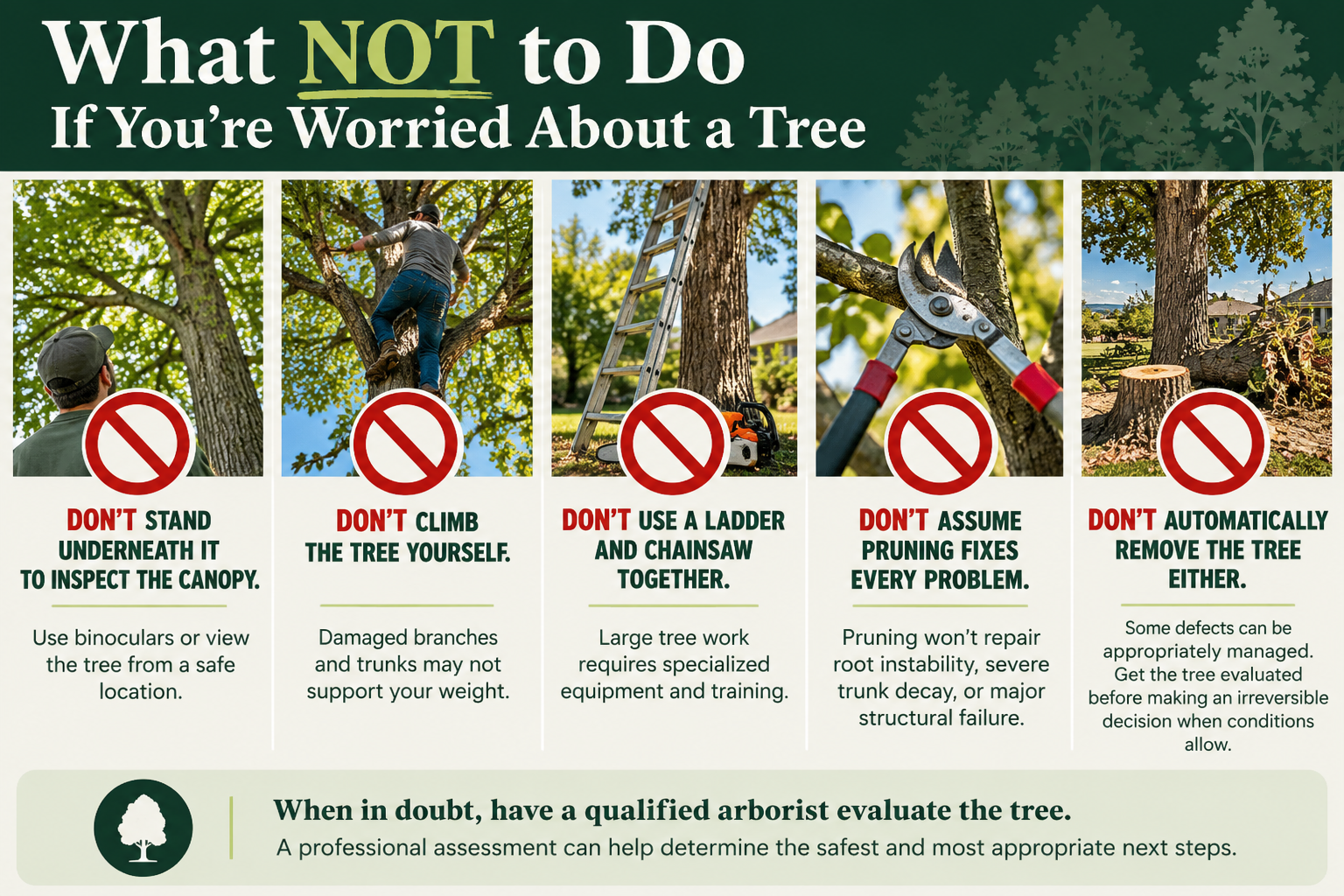
Visible root movement combined with a new tree lean is a reason to take the situation seriously. Avoid standing beneath the tree while inspecting it.
6. There Is Significant Decay or a Large Cavity
Trees can sometimes remain structurally sound despite cavities or decay. A hollow-looking tree is not automatically a dangerous tree. But extensive decay can reduce the amount of sound wood supporting the tree.
Watch for:
Large cavities
Soft or crumbling wood
Sections of missing bark
Decay around old pruning wounds
Large areas of dead trunk tissue
Hollow sounds or visible interior deterioration
The important question isn't simply whether decay exists. It's where the decay is located and how much structurally sound wood remains. That's difficult to determine from appearance alone, which is why significant trunk decay should be professionally evaluated.
7. Mushrooms or Fungal Growth Are Appearing Around the Base
A mushroom growing in the yard doesn't necessarily mean your tree is dangerous. But fungal fruiting bodies growing directly from the trunk, root flare, or major roots can sometimes indicate decaying wood below the surface.
Pay attention to mushrooms or conks that:
Grow directly from the trunk
Repeatedly appear at the tree's base
Grow from exposed roots
Appear alongside declining canopy health
Fungal identification matters. Some fungi decompose dead organic matter and pose little concern, while others may be associated with wood or root decay. Don't remove the mushrooms and assume the problem is gone. The visible mushroom may only be the fruiting structure of a much larger fungal organism.
8. A Large Branch Is Cracked or Hanging
A partially broken branch can sometimes be more concerning than one already lying on the ground. Large limbs can crack without completely detaching.
Look for:
Freshly exposed wood
Hanging branches
Torn bark
Branches resting on other limbs
A sudden change in branch angle
Cracks at major branch unions
Never stand underneath a hanging branch to inspect it. And don't attempt to pull down a large suspended limb yourself. Storm-damaged branches can be under considerable tension and may move unpredictably when cut.
Our Storm-Damaged Trees: What to Do After High Winds in Southern Utah guide explains what homeowners should do following severe weather.
9. The Tree Is Dying Back From the Top
A thinning canopy doesn't necessarily mean a tree is dangerous. However, substantial canopy dieback can indicate a significant underlying health problem.
Watch for:
Dead upper branches
Progressive canopy thinning
Large areas that don't leaf out
Premature leaf loss
Declining branch tips
Increasing deadwood from year to year
Possible causes include:
Root problems
Drought stress
Irrigation issues
Insects
Disease
Soil problems
Previous damage
A declining tree isn't automatically structurally unsafe, but increasing amounts of deadwood can create additional branch-failure concerns. This is where a broader tree-health evaluation becomes important.
10. Something About the Tree Changed Suddenly
Sometimes the most important warning sign is simply:
“That wasn't like that before.”
Maybe the tree suddenly leans.
Maybe a crack appeared.
Maybe a large branch dropped on a calm day.
Maybe the canopy declined rapidly.
Maybe soil started lifting around the roots.
Significant, unexplained changes deserve attention.
Trees grow slowly, so sudden structural changes can be particularly meaningful. Take photos when you first notice something unusual. Comparing them over time can help determine whether the condition is progressing.
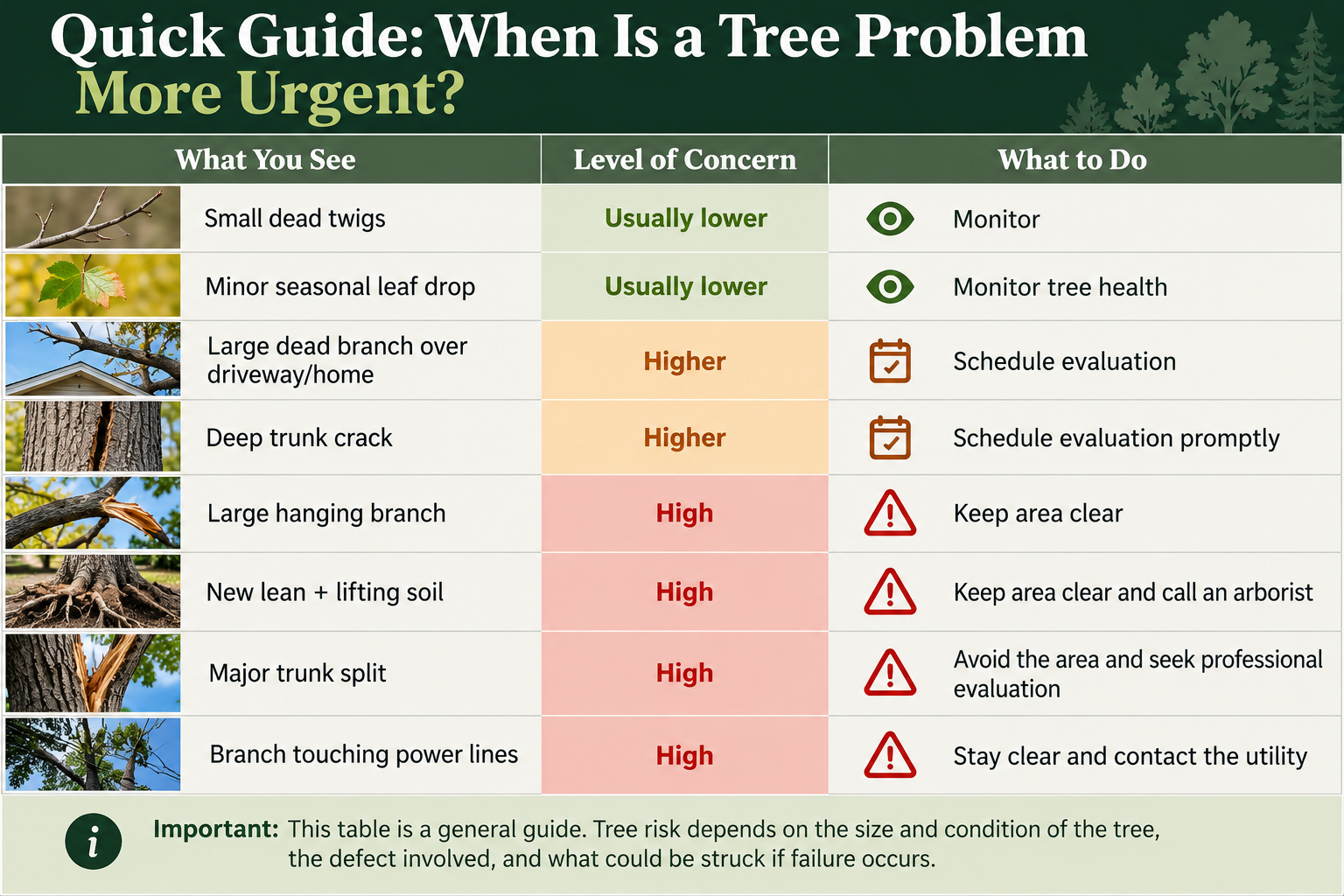
A Defect Doesn't Automatically Mean a Tree Is Dangerous
This distinction matters. A cavity, lean, dead branch, or unusual trunk union isn't enough by itself to determine that a tree needs to be removed.
Tree risk depends partly on:
The tree + the likelihood of failure + what could be hit.
For example, a dead branch hanging over an unused section of an open property presents a different situation than the same branch hanging over a front entrance. Professional assessment considers the whole picture rather than one scary-looking symptom.
Can a Dangerous Tree Be Saved?
Sometimes. The solution isn't always removal.
Depending on the tree and problem, an arborist may recommend:
Removing deadwood
Corrective pruning
Structural pruning
Reducing a specific limb
Monitoring a defect
Improving root-zone conditions
Addressing irrigation problems
Managing insects or disease
In other situations, the amount of structural damage or decline may make removal the most appropriate option. The important part is determining which situation you're actually dealing with.
Southern Utah Trees Face Unique Stress
Tree safety can't be separated from tree health. Trees throughout Washington County regularly experience:
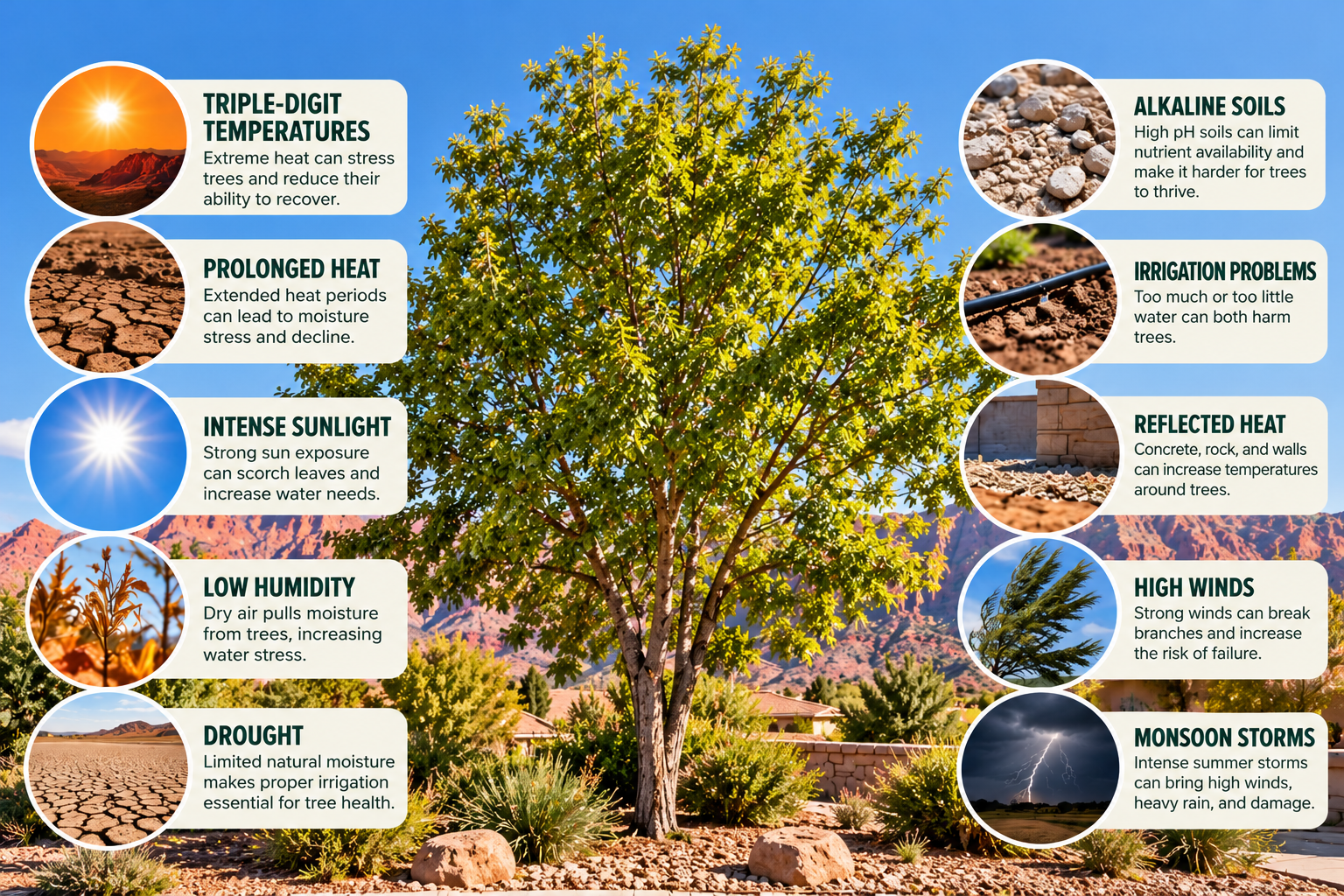
A chronically stressed tree may have less ability to respond to additional damage.
That's why proper tree care southern utah isn't simply about appearance. Maintaining tree health and structure over time can help identify problems before they become more serious.
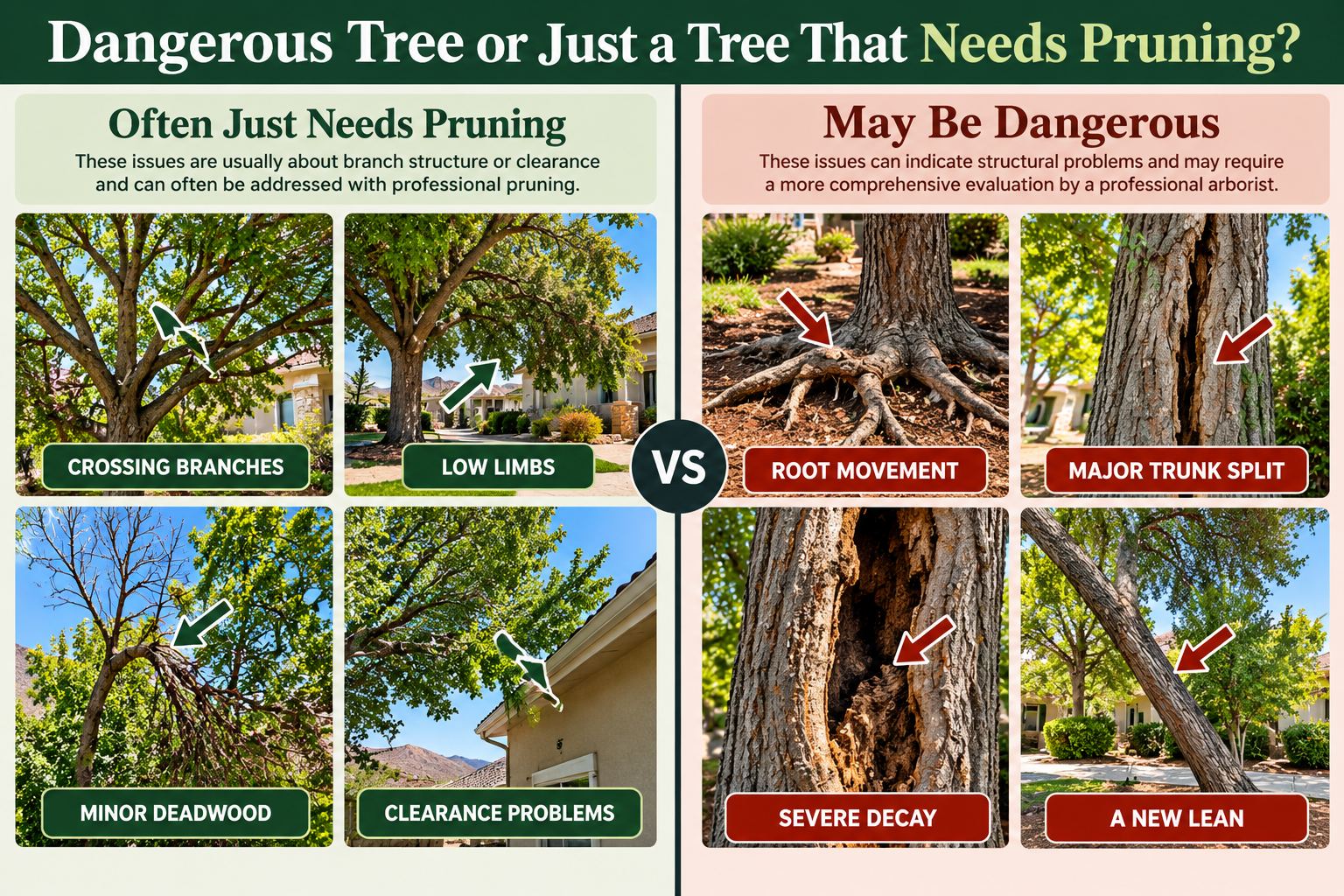
Read 10 Signs Your Tree Needs Pruning in Southern Utah if the tree appears healthy but you're concerned about its branches or structure.
If you're noticing multiple health or structural symptoms, our When to Call an Arborist: 10 Signs Your Tree Needs Professional Help guide is a better next step.
Don't Wait for the Next Windstorm to Find Out
Southern Utah's strong winds have a way of exposing tree problems. Unfortunately, by then, a weak branch or structural defect may already have failed.
If you notice a major crack, hanging limb, new lean, root movement, significant decay, or another structural change, having the tree evaluated before the next storm can give you more options.
Master Arbor provides professional tree evaluations throughout St. George, Washington City, Hurricane, Santa Clara, Ivins, Silver Reef, and Washington County.
Worried a Tree May Be Dangerous?
Master Arbor can help with:
Tree safety evaluations
Structural assessments
Dead and hazardous branch removal
Corrective pruning
Storm-damage evaluations
Tree-health diagnosis
Root-zone concerns
Tree preservation
Tree removal when appropriate
Contact Master Arbor today to schedule an evaluation and find out whether your tree needs monitoring, pruning, treatment, or removal.
Related Articles
Frequently Asked Questions
-
Warning signs can include a new or increasing lean, lifting soil, root movement, major trunk cracks, splitting stems, extensive decay, and significant structural damage. No single symptom proves that a tree will fall, so concerning changes should be professionally evaluated.
-
No. Some healthy trees naturally grow at an angle. A new lean or one that is increasing—especially when accompanied by lifting soil, exposed roots, or ground cracking—is more concerning.
-
Not necessarily. Trees can sometimes remain structurally viable despite cavities. The location and extent of decay and the amount of sound supporting wood are important factors that should be evaluated before deciding whether removal is necessary.
-
Large dead branches can eventually fail, especially during wind or storms. Deadwood over homes, driveways, sidewalks, patios, or other frequently occupied areas deserves particular attention.
-
A qualified arborist can evaluate the tree's health, roots, trunk, branches, structural defects, surrounding targets, and other factors to determine appropriate next steps. If the tree or branches are contacting electrical lines, stay clear and contact the utility provider.
