
Why Is My Tree Losing Leaves in Summer? 8 Common Causes in Southern Utah
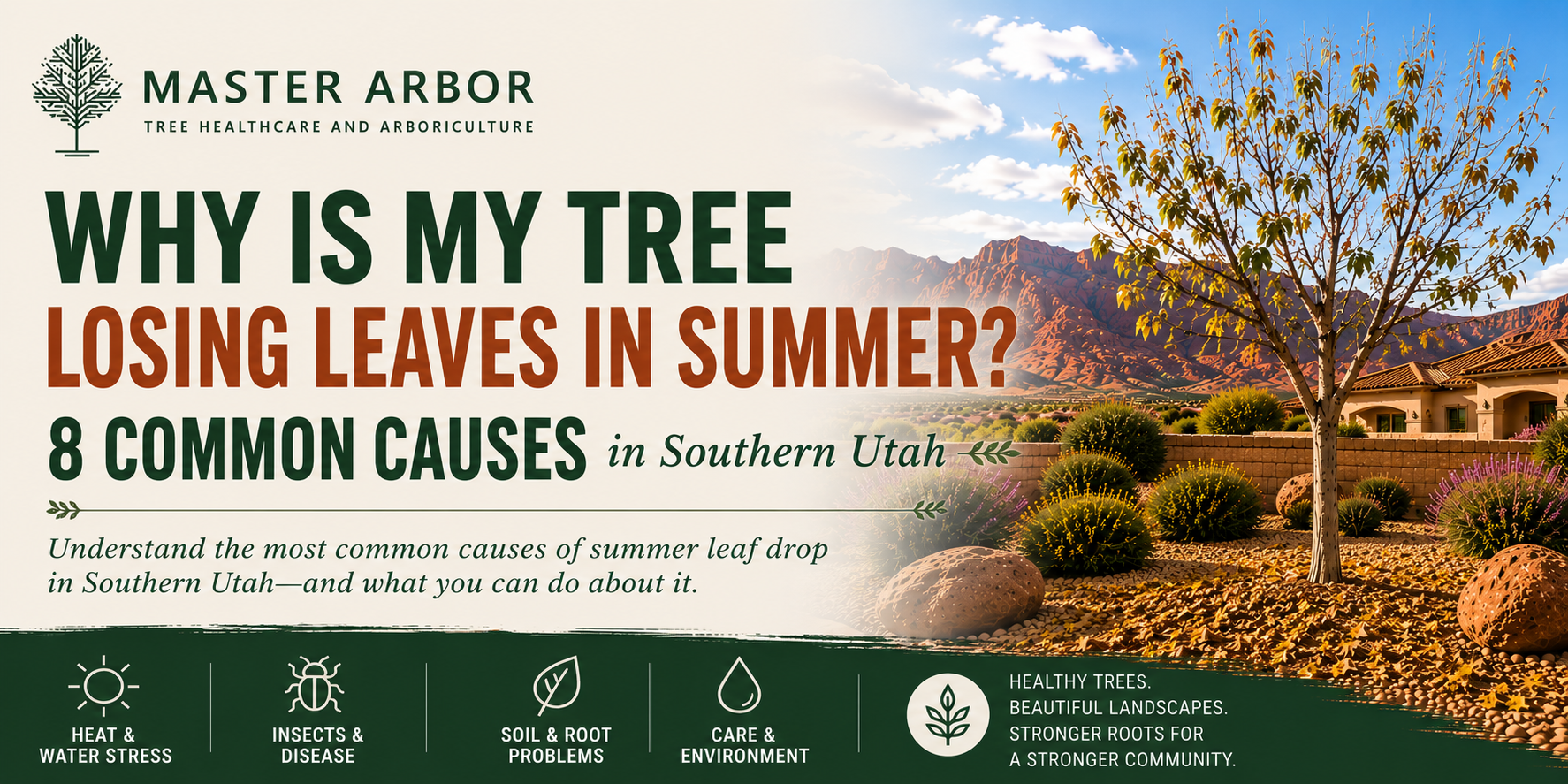
It’s the middle of summer in Southern Utah. Your lawn is green, the sun is blazing, and suddenly your tree starts dropping leaves like it’s October.
Is your tree dying?
Not necessarily.
Trees can lose leaves during summer for several reasons, and in St. George, Hurricane, Washington City, Ivins, Santa Clara, and throughout Washington County, extreme heat and dry conditions make premature leaf drop especially common.
Sometimes dropping leaves is actually a tree’s way of protecting itself. Other times, it can be an early warning sign of a more serious problem involving irrigation, roots, insects, disease, or soil conditions.
At Master Arbor, we help Southern Utah homeowners determine what their trees are telling them and address problems before temporary stress turns into permanent decline.
Here are eight of the most common reasons trees lose leaves during summer.
1. Extreme Heat Stress
Southern Utah summers can be brutal on trees.
When temperatures remain in the triple digits, trees lose enormous amounts of moisture through their leaves. If the root system cannot replace that moisture quickly enough, the tree may begin shedding leaves.
Think of it as a survival strategy.
By reducing the number of leaves it has to support, the tree reduces water loss and conserves resources for its roots, trunk, and remaining canopy.
Signs of heat stress include:
Wilting leaves
Brown or crispy leaf edges
Curling leaves
Yellowing foliage
Premature leaf drop
Thinning canopy
Trees surrounded by rock landscaping, concrete, block walls, driveways, or artificial turf may experience even more heat because these surfaces absorb and radiate heat around the tree.
If leaf loss begins during or immediately after a prolonged heat wave, heat stress should be one of the first things you consider.
Related Article: Protect Your Trees from Extreme Heat in Southern Utah
2. Your Tree Isn't Getting Enough Water
Underwatering is one of the most common causes of summer leaf loss in Southern Utah.
A tree may appear to be receiving plenty of water because the lawn or landscaping is irrigated regularly. Unfortunately, irrigation designed for grass and shrubs may not penetrate deeply enough to reach the tree's root system.
Trees need water to reach deeper into the soil.
Shallow irrigation can encourage shallow roots and leave trees vulnerable when temperatures climb.
Signs your tree may need deeper watering include:
Dry soil several inches below the surface
Wilting leaves
Brown leaf margins
Leaf scorch
Premature leaf drop
Branch dieback
Proper tree care southern utah should include deep watering that reaches the active root zone rather than simply wetting the soil around the trunk.
Related Article: Deep Watering Done Right: 8 Tips for Healthier Trees
3. Your Tree May Be Getting Too Much Water
It sounds contradictory, but too much water can produce many of the same symptoms as too little water.
Roots need both moisture and oxygen.
When soil remains saturated for extended periods, oxygen levels around the roots decline. Damaged roots become less effective at absorbing water and nutrients, causing the canopy to suffer.
Watch for:
Yellow leaves
Soft or consistently wet soil
Leaf drop
Weak new growth
Branch dieback
Before adding more water to a struggling tree, check the soil.
The goal isn't simply to water more. It's to water correctly.
4. Leaf Scorch
Leaf scorch is extremely common during Southern Utah summers.
It occurs when leaves lose moisture faster than the tree's roots can replace it.
The damage usually begins along the outer edges or tips of leaves before progressing inward.
Leaf scorch often looks like:
Brown leaf margins
Crispy tips
Dry patches between leaf veins
Curling leaves
Premature leaf drop
Leaf scorch isn't always caused by a lack of irrigation. High temperatures, reflected heat, wind, damaged roots, poor soil, and inadequate water uptake can all contribute.
If you're seeing brown edges before the leaves fall, read our guide to Tips to Manage Summer Leaf Scorch in Southern Utah.
5. Insects Are Stressing the Tree
Insect infestations can cause trees to shed leaves prematurely, particularly when the tree is already stressed by summer heat.
Common Southern Utah tree pests include:
Aphids
Spider mites
Scale insects
Borers
Look closely for:
Sticky residue on leaves or surfaces beneath the tree
Fine webbing
Tiny insects underneath leaves
Small bumps attached to twigs or branches
Distorted foliage
Holes in bark
Branch dieback
Spider mites can become especially problematic during hot, dry weather.
A healthy tree may tolerate a minor pest population, but insects combined with drought or heat stress can push a struggling tree into decline.
Professional tree insect prevention southern utah can help identify the pest and determine whether treatment is necessary.
6. Root Problems
When homeowners see leaves falling, they naturally look at the canopy.
But the real problem may be underground.
Tree roots can be damaged by:
Construction
Trenching
Soil compaction
Landscape renovations
Changes in irrigation
Poor drainage
Excessive soil placed over roots
Root-zone disturbance
If a tree begins declining after a new patio, driveway, retaining wall, pool, irrigation system, or landscaping project, root damage should be considered.
Trees can sometimes take weeks or months to show the effects of root disturbance.
7. Alkaline Soil and Nutrient Problems
Southern Utah's soils can make certain nutrients difficult for trees to absorb.
One of the most recognizable symptoms is chlorosis, which causes leaves to become pale green or yellow.
You may notice:
Yellow leaves with greener veins
Pale foliage
Weak growth
Smaller-than-normal leaves
Premature leaf loss
Adding fertilizer isn't always the answer.
If the problem involves soil chemistry or root function, simply adding nutrients may not correct the underlying issue.
A professional tree-health evaluation can help determine what's actually happening before treatment begins.
8. The Tree Is Protecting Itself
Sometimes summer leaf drop looks alarming but is actually a defensive response.
A tree experiencing severe environmental stress may deliberately shed some leaves to reduce the amount of moisture it loses through transpiration.
If conditions improve, the tree may stabilize.
The key question is how much canopy is being lost and whether other symptoms are present.
A small amount of leaf drop following extreme heat may not be an emergency.
Rapid defoliation, significant branch dieback, bark damage, or widespread canopy decline deserves closer attention.
Is My Tree Dying or Just Stressed?
One of the hardest things for homeowners to determine is whether summer leaf loss represents temporary stress or actual tree decline.
A stressed tree may still have:
Flexible branches
Healthy buds
Firm bark
Green tissue beneath the bark
Healthy foliage elsewhere in the canopy
More concerning signs include:
Large dead branches
Rapid canopy thinning
Cracking or peeling bark
Extensive branch dieback
Cavities or decay
Significant insect activity
Mushrooms or fungal growth around the base
A sudden lean
Large sections of completely dead canopy
If you're wondering how to save a dying tree, identifying the underlying cause is the first step. Watering a tree more won't fix root rot, and fertilizer won't solve an insect infestation.
What Should You Do When a Tree Starts Losing Leaves?
Start with a few simple checks.
Check the soil.
Dig several inches below the surface in the root zone. Is it extremely dry, moist, or saturated?
Look closely at the leaves.
Are they yellow, scorched, curled, spotted, sticky, or covered with fine webbing?
Inspect the trunk and branches.
Look for cracks, holes, peeling bark, dead limbs, or unusual growth.
Think about recent changes.
Has irrigation changed? Was landscaping installed? Has construction occurred nearby? Did the symptoms begin during a heat wave?
Don't immediately fertilize.
Stressed trees don't always benefit from fertilizer, and unnecessary treatments can make certain problems worse.
When the cause isn't obvious, an arborist can evaluate the entire tree rather than treating one symptom.
Don't Ignore Sudden Summer Leaf Drop
A few fallen leaves during a Southern Utah summer aren't necessarily cause for alarm.
But if your tree suddenly begins losing significant amounts of foliage, something has changed.
Catching problems early gives you the best opportunity to protect the tree before stress progresses into major branch loss or permanent decline.
Master Arbor provides professional tree-health evaluations throughout St. George, Hurricane, Washington City, Santa Clara, Ivins, Silver Reef, and Washington County.
Get Answers Before Your Tree Gets Worse
Is your tree dropping leaves, turning yellow, developing brown edges, or looking thinner than it did earlier this summer?
Don't guess at the treatment.
Master Arbor can evaluate your tree, identify the underlying problem, and recommend the appropriate next step for Southern Utah's unique growing conditions.
We Can Help With:
Watering and irrigation recommendations
Heat-stress diagnosis
Insect identification and treatment
Soil and nutrient concerns
Root-zone problems
Hazard and decline assessments
Contact Master Arbor today to schedule a tree-health consultation and find out what's causing your tree to lose leaves.
Frequently Asked Questions
-
Some summer leaf drop can occur when trees experience extreme heat or temporary water stress. However, rapid or significant leaf loss can indicate irrigation problems, root damage, insects, nutrient issues, or other health concerns.
-
Green leaves may drop because of sudden heat stress, changes in watering, root problems, strong winds, or other environmental stress. The condition of the tree and the amount of foliage being lost can help determine whether the problem is serious.
-
Yes. Saturated soil can reduce oxygen around tree roots and interfere with water and nutrient absorption. This can cause yellowing, weak growth, leaf drop, and eventually root decline.
-
A tree that remains healthy may recover from temporary heat stress, although severely damaged leaves generally will not repair themselves. Recovery depends on the tree species, severity of stress, root health, and whether the underlying cause is corrected.
-
Consider having the tree inspected if leaf loss is rapid or extensive, large branches are dying, bark is damaged, insects are present, or the tree continues declining after watering and environmental conditions improve.
