
10 Signs Your Tree Needs Pruning in Southern Utah
Trees don't need to look perfectly symmetrical to be healthy. In fact, one of the biggest mistakes homeowners make is assuming a tree needs pruning simply because it looks too large, uneven, or messy.
Good pruning isn't about making a tree smaller. It's about making strategic cuts that improve its health, structure, clearance, and safety while preserving as much healthy canopy as possible.
That distinction is especially important in Southern Utah, where trees already contend with extreme heat, intense sunlight, dry conditions, high winds, and limited water. So how do you know when your tree actually needs to be pruned?
If you live in St. George, Hurricane, Washington City, Santa Clara, Ivins, Silver Reef, or elsewhere in Washington County, here are 10 signs it's time to take a closer look.
1. Your Tree Has Dead Branches
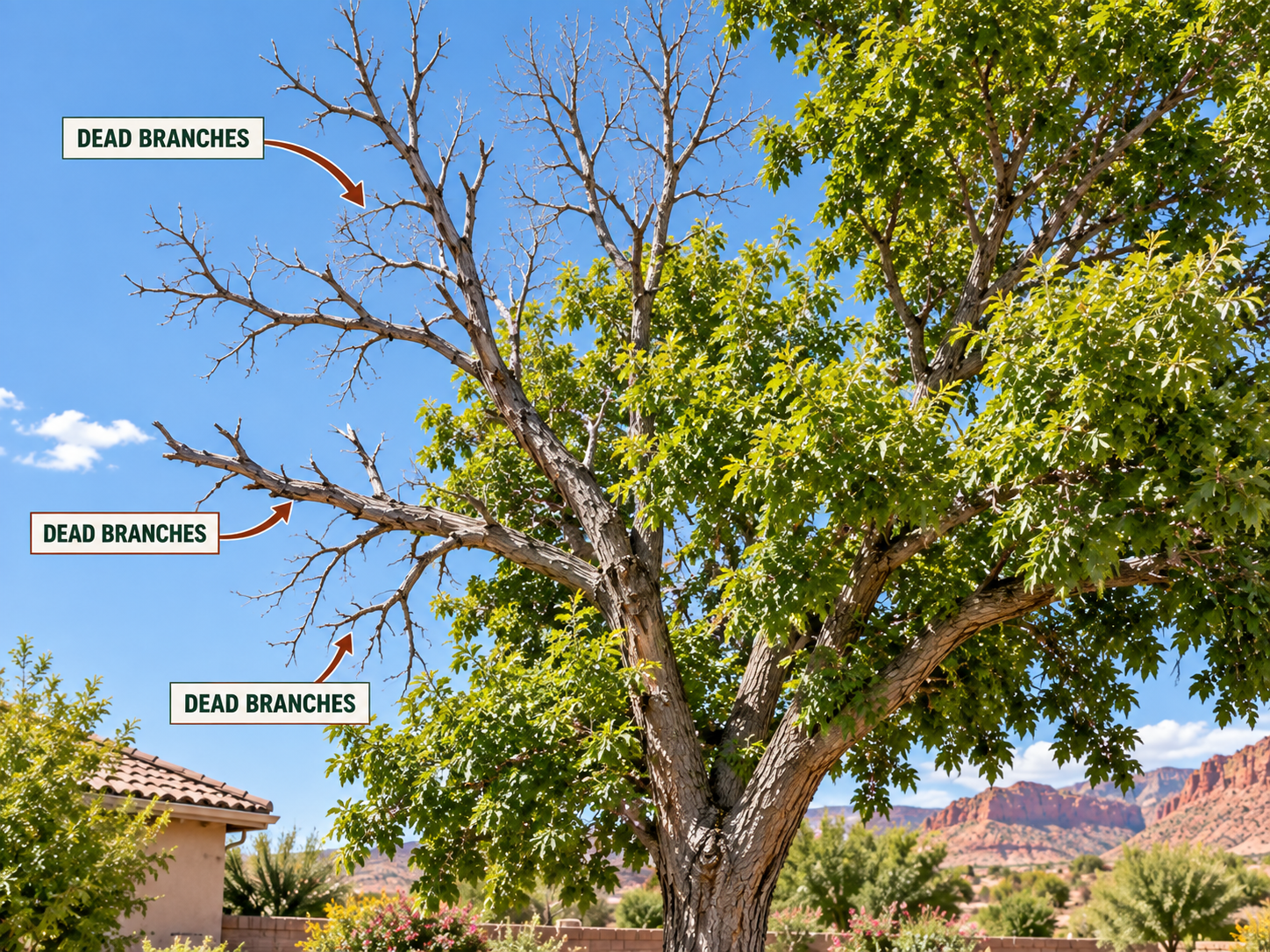
Deadwood is one of the clearest reasons to consider pruning.
A dead branch may:
Have no leaves while surrounding branches are healthy
Develop brittle twigs
Lose bark
Show no healthy buds
Become increasingly dry or brittle
Small dead twigs aren't necessarily an emergency. Large dead branches—especially those over a home, driveway, sidewalk, patio, pool, or other frequently used area—deserve more attention. Dead branches no longer have the flexibility and living tissue of healthy limbs and can eventually fail. Appropriate tree pruning southern utah removes deadwood while preserving healthy portions of the canopy.
2. Branches Are Broken or Hanging

Storms don't always cause branches to fall completely. Sometimes a limb cracks but remains partially attached to the tree. These hanging branches can be difficult to see from the ground and may fall later with little warning.
Look for:
Freshly exposed wood
Splintered branches
Torn bark
Limbs hanging at unusual angles
Branches caught in other limbs
Southern Utah's high winds and seasonal storms can reveal weaknesses that were already present in a tree. If a large branch is broken or suspended in the canopy, don't stand beneath it or attempt to remove it from a ladder.
Related Article: Storm-Damaged Trees: What to Do After High Winds in Southern Utah
3. Branches Are Crossing or Rubbing Together

Look inside the canopy. Do you see branches growing across one another? When two branches repeatedly rub together in the wind, they can damage each other's bark. Over time, that can create wounds and weaken one or both limbs. Crossing branches are particularly useful to address while trees are young. Removing a small, poorly positioned branch early is generally preferable to waiting until it becomes a large structural limb.
4. The Tree Has Weak Branch Unions

Some trees naturally develop multiple stems or branches with narrow attachment angles. These aren't automatically dangerous, but certain branch unions can become structurally weaker as the tree matures.
Watch for:
Two large stems growing tightly together
Narrow V-shaped unions
Bark compressed between stems
Cracking where major limbs meet
Multiple competing leaders on young trees
This is where structural pruning becomes particularly valuable. Correcting poor structure while a tree is young can help prevent much larger pruning problems later.
5. Branches Are Touching Your Roof or Home

A healthy tree can still need pruning for clearance.
Branches may eventually grow into:
Rooflines
Gutters
Siding
Windows
Walls
Walkways
Driveways
Branches repeatedly rubbing against a structure can damage both the tree and the property. The solution isn't necessarily to heavily cut back the entire side of the tree. Selective pruning can create appropriate clearance while maintaining a balanced canopy. If the tree was planted too close to the structure, an arborist can also help determine how sustainable the situation will be as the tree continues growing.
6. Branches Are Blocking Streets, Sidewalks, or Visibility

Trees sometimes outgrow the clearance available around them.
Low or poorly positioned branches may interfere with:
Sidewalks
Driveways
Street visibility
Vehicles
Pedestrian areas
Landscape access
This is another situation where selective pruning is generally better than removing large amounts of canopy. The goal is to solve the clearance problem while retaining healthy branches wherever possible.
7. The Canopy Is Extremely Dense
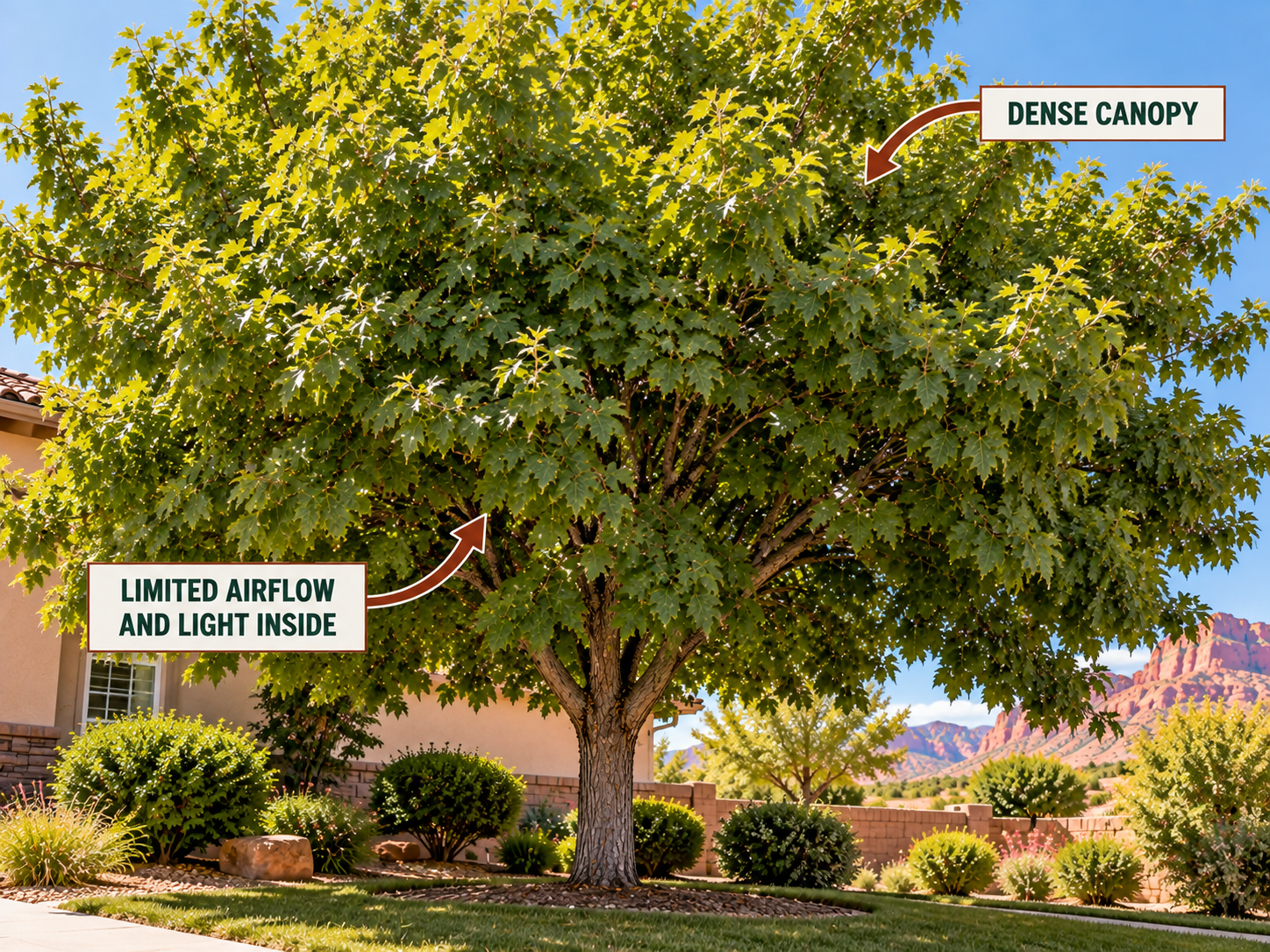
A dense tree isn't automatically unhealthy. However, excessive interior growth can sometimes create problems with structure, clearance, or branch development. The answer is not to aggressively thin the tree.
Over-thinning can:
Remove too much leaf area
Increase sun exposure on previously shaded bark
Encourage excessive sprouting
Alter branch loading
Increase stress
This is particularly important in Southern Utah. A tree's canopy helps shade its trunk and branches from intense desert sunlight. Removing too much foliage at once can suddenly expose bark that isn't accustomed to full sun. Professional pruning should be purposeful, not simply focused on making the canopy look thinner.
8. Your Young Tree Has Poor Structure
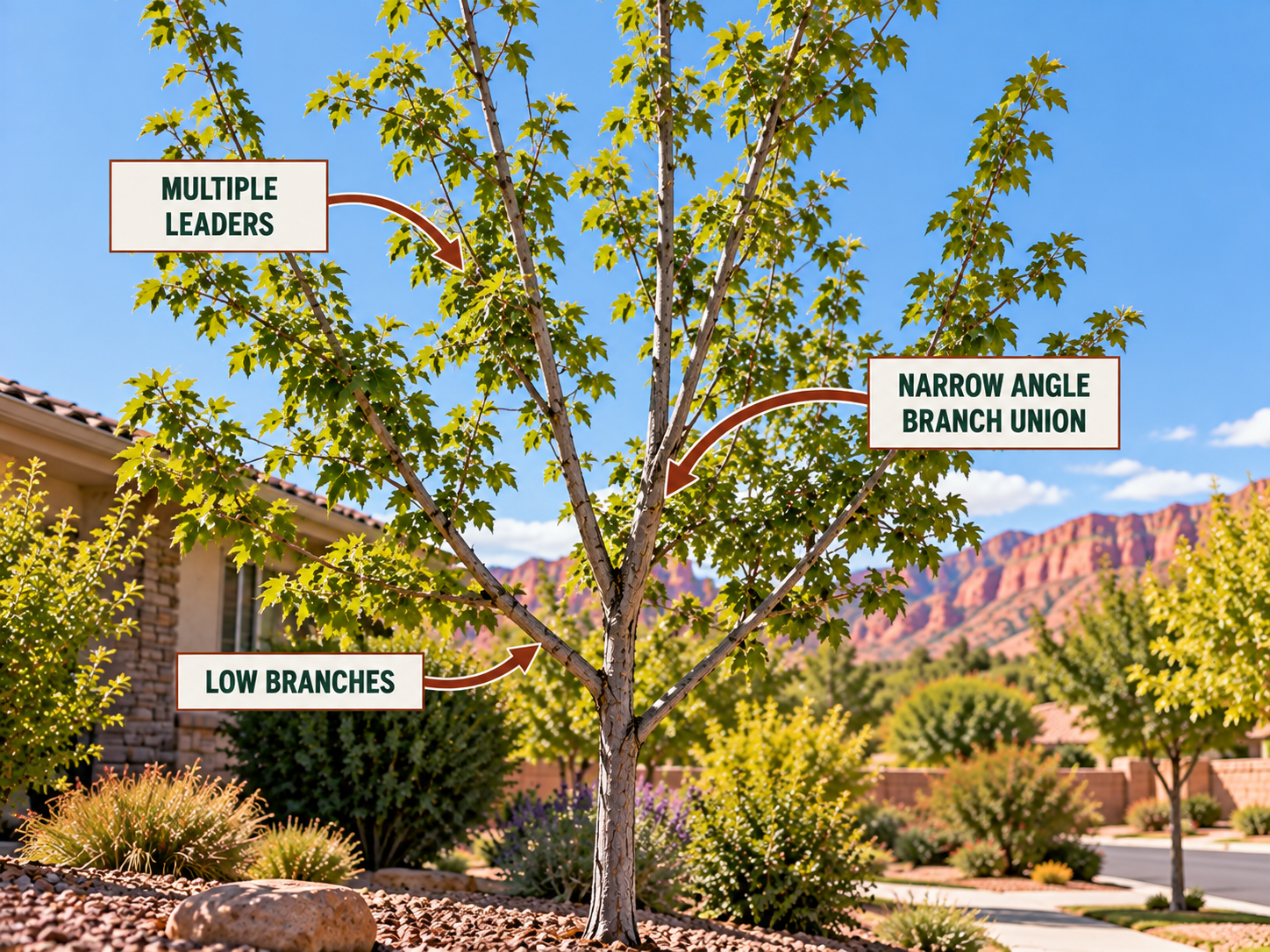
Some of the most valuable pruning happens long before a tree becomes large.
Young-tree structural pruning can help establish:
A strong central leader when appropriate
Better branch spacing
Stronger branch attachments
Better clearance
A more sustainable mature structure
Think of it as guiding the tree while corrections are still small. A branch that can be removed with a small pruning cut today might require a chainsaw ten years from now. For homeowners planting new trees in Southern Utah, early structural care can be one of the best investments in the tree's long-term health.
9. Your Tree Was Damaged by Wind or a Storm
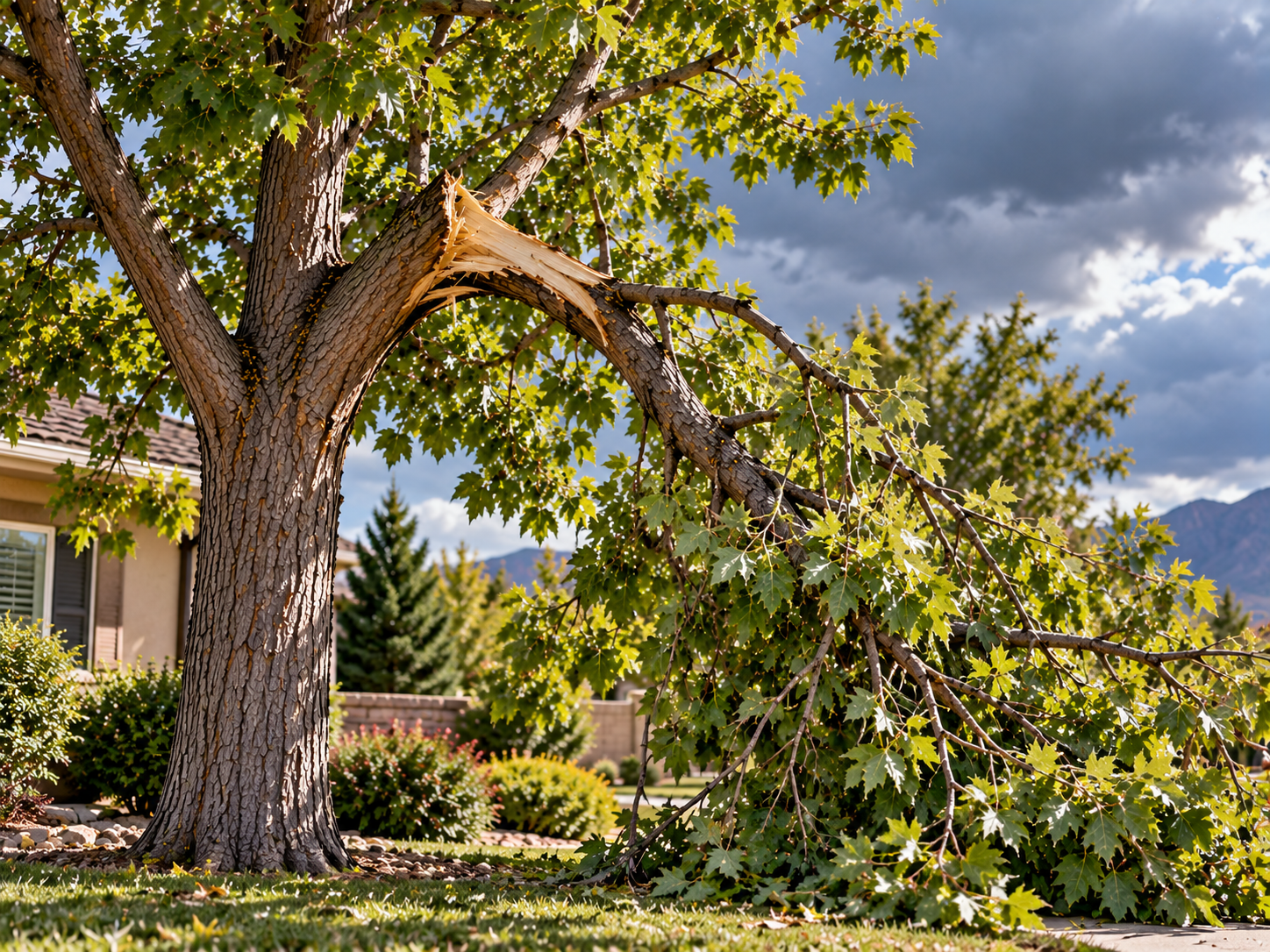
After a Southern Utah windstorm or monsoon event, inspect trees from a safe distance.
Even if nothing large fell, look for:
Cracked branches
Torn limbs
Hanging branches
Split unions
Fresh wounds
Changes in canopy position
Storm cleanup isn't simply about cutting off everything that looks damaged. Some branches may need corrective pruning back to an appropriate union, while others may still be structurally viable. If the trunk, major limbs, or roots were affected, the tree may need a broader structural evaluation rather than routine pruning.
10. It's Been Years Since Anyone Evaluated the Tree
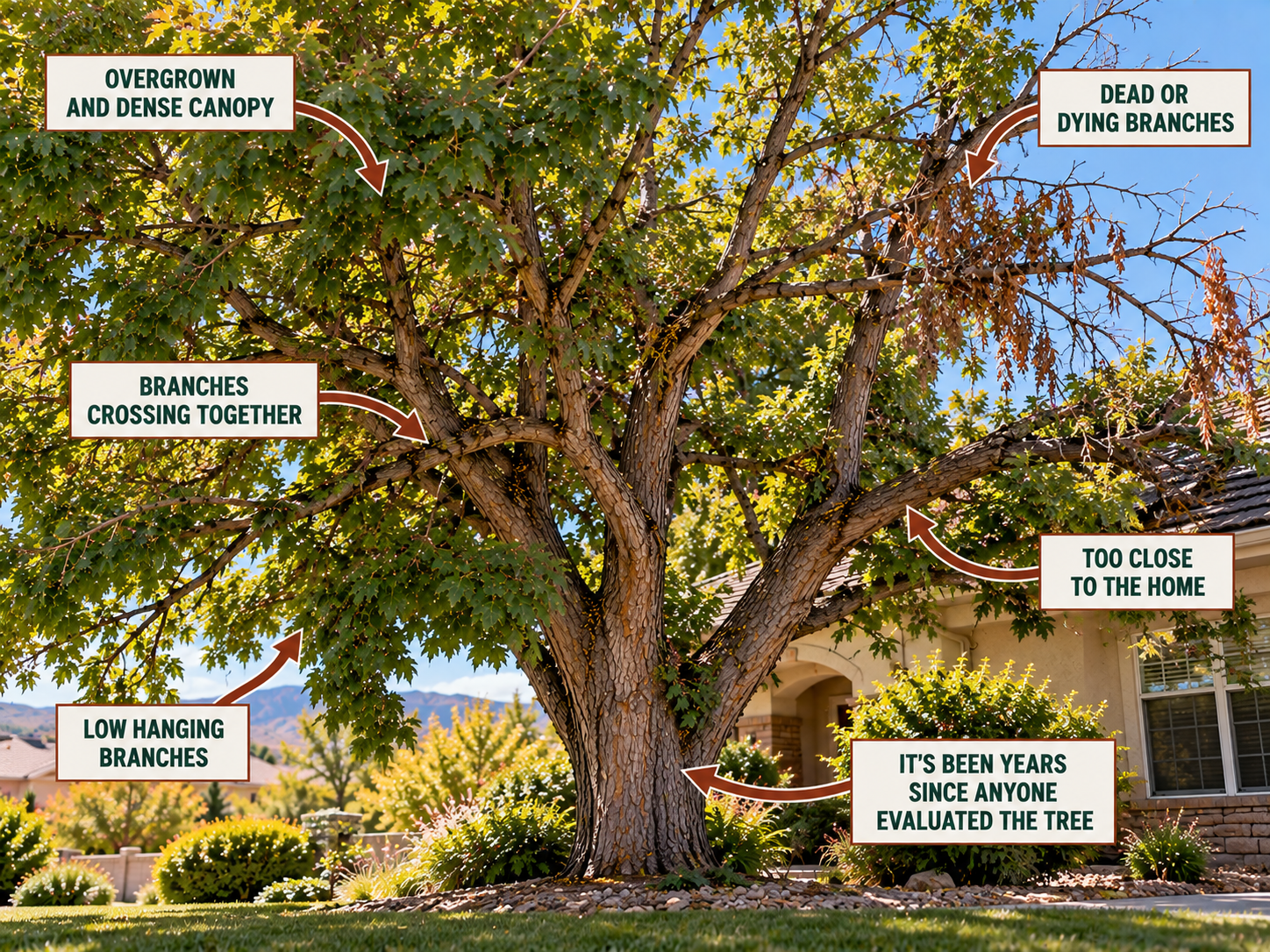
Trees don't necessarily need pruning every year. But mature trees can change considerably over time. Branches grow longer and heavier. Old pruning cuts change. Deadwood develops. Nearby structures change. Irrigation and landscaping may change as well.
If you have large trees near your:
Home
Driveway
Pool
Patio
Play area
Neighboring property
Periodic professional evaluation can identify pruning needs before obvious problems develop. That doesn't mean an arborist will recommend pruning every time. Sometimes the best recommendation is: Leave the tree alone.
Signs Your Tree May Need an Arborist—Not Just Pruning
Pruning isn't a treatment for every tree problem.
If you're seeing:
Widespread canopy decline
Significant yellowing
Rapid leaf loss
Large areas of branch dieback
Bark damage
Insect activity
Root movement
A new lean
Trunk cracks
Fungal growth
The tree may need a health or structural evaluation first. Cutting branches won't fix an irrigation problem, root damage, nutrient issue, or insect infestation. Our guide When to Call an Arborist: 10 Signs Your Tree Needs Professional Help can help you determine when the issue goes beyond routine pruning.
What Is the Best Time to Prune Trees in Southern Utah?
The ideal timing depends on the tree species and reason for pruning. Dormant-season pruning is appropriate for many deciduous trees because the branch structure is easier to see and the tree isn't actively producing leaves.
However, pruning may be appropriate at other times when addressing:
Dead branches
Broken limbs
Storm damage
Safety concerns
Clearance problems
One thing we generally want to avoid is unnecessary heavy pruning during extreme Southern Utah heat. Removing too much canopy during hot weather can increase stress and expose previously shaded bark and branches to intense sunlight. The right timing depends on the tree and the objective.
How Much of a Tree Should Be Pruned at Once?
More is not better. Leaves manufacture the energy a tree needs to maintain roots, defend itself, and grow. Removing excessive healthy foliage can stress the tree.
The amount that can appropriately be removed depends on:
Tree age
Species
Health
Size
Previous pruning
Time of year
Reason for pruning
A mature stressed tree may tolerate significantly less canopy removal than a vigorous young tree undergoing structural training. That's why arbitrary rules like “remove 30% of the canopy” aren't good pruning plans. Every tree is different.
Why Tree Topping Isn't Pruning
If a tree is getting too large, cutting the top off may seem like the fastest solution. Unfortunately, topping can create long-term problems. Tree topping removes branches at arbitrary points rather than making cuts at appropriate branch unions.
It can lead to:
Large wounds
Decay
Rapid sprout growth
Weakly attached new branches
Loss of shade
Increased sun exposure
Poor long-term structure
If a tree is genuinely too large for its location, an arborist can determine whether selective reduction pruning is appropriate—or whether the tree simply wasn't planted in a sustainable location.
Can I Prune My Own Tree?
For small branches accessible from the ground, homeowners may be able to perform limited pruning with appropriate tools and knowledge.
Professional help is a better choice when:
Branches are large
Work requires climbing
A ladder would be needed with cutting equipment
Limbs are hanging or under tension
The tree has storm damage
Branches are near utility lines
Large structural branches are involved
You're unsure where the correct pruning cut should be
Tree work becomes much more dangerous once gravity, height, heavy limbs, and cutting equipment are involved. Never attempt pruning near electrical lines.
Good Pruning Should Have a Reason
Before any branch is removed, there should be an answer to one simple question:
Why are we cutting this branch?
Good reasons might include:
Deadwood. Structural improvement. Clearance. Storm damage. Broken branches. Risk reduction. Young-tree development.
“Because the tree hasn't been trimmed lately” isn't necessarily one of them. Professional tree care isn't about removing the most branches. It's about making the right cuts for the right reasons.
Does Your Tree Actually Need Pruning?
If you're unsure, that's exactly where a professional evaluation can help. Master Arbor provides tree-health and professional pruning services throughout St. George, Washington City, Hurricane, Santa Clara, Ivins, Silver Reef, and Washington County.
We'll look at the tree's:
Health
Structure
Deadwood
Branch attachments
Clearance
Previous pruning
Surrounding property
Long-term growth
Then we can determine what should be pruned—and equally important, what should stay.
Schedule a Professional Tree Evaluation
Master Arbor can help with:
Structural pruning
Young-tree pruning
Deadwood removal
Clearance pruning
Corrective pruning
Storm-damage pruning
Tree-health evaluations
Hazardous branch assessments
Tree preservation
Contact Master Arbor today to schedule a professional tree evaluation and find out whether your tree actually needs pruning.
Frequently Asked Questions
-
Common signs include dead or broken branches, crossing or rubbing limbs, poor branch structure, branches contacting buildings or blocking access, storm damage, and hanging limbs. An arborist can determine whether pruning is actually necessary and which branches should be removed.
-
There isn't one schedule for every tree. Pruning frequency depends on species, age, growth rate, location, health, and pruning objectives. Young trees may benefit from periodic structural pruning, while healthy mature trees may require less frequent intervention.
-
Timing depends on the tree species and purpose of pruning. Dormant-season pruning works well for many deciduous trees, while dead, broken, or hazardous branches may need attention whenever they're identified.
-
Appropriate structural pruning can address certain weak or poorly positioned branches, but no pruning technique can make a tree storm-proof. Excessive thinning or topping can actually create additional problems.
-
No. Topping removes large branches at arbitrary points and can result in large wounds, decay, excessive sprouting, and weak future growth. Professional pruning makes purposeful cuts based on tree biology and structure.
