
Best Trees for Homes in Ivins, Utah
How to Choose Trees That Thrive in Ivins’ Desert Climate
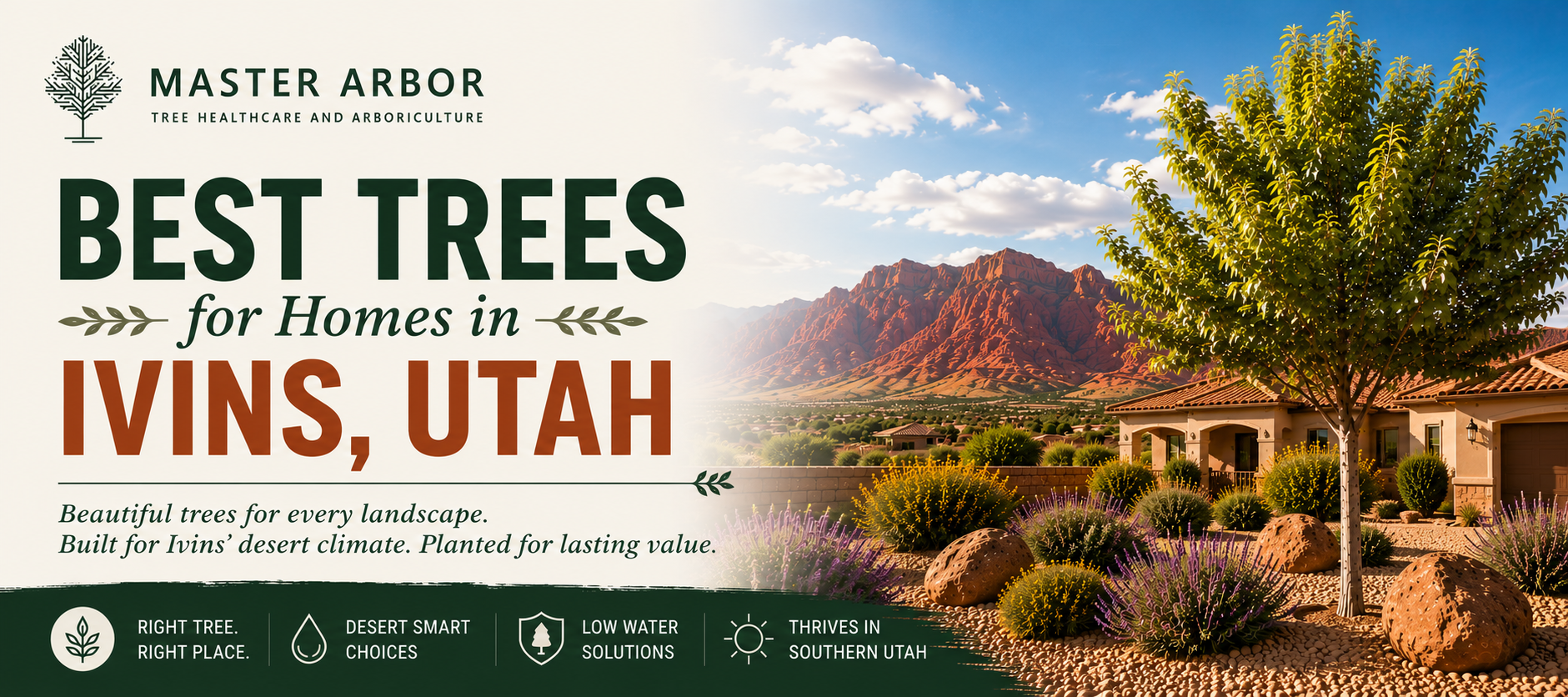
A well-chosen tree can completely transform an Ivins property. It can add cooling shade, improve curb appeal, create privacy, soften a rock-heavy landscape, and make an outdoor space more enjoyable during Southern Utah’s hottest months.
However, choosing a tree based only on its appearance at the nursery can lead to years of problems.
Trees planted in Ivins, Utah, must be able to handle intense summer heat, dry air, alkaline soil, limited rainfall, strong sun exposure, and occasional high winds. A species that performs well in a cooler climate may require excessive water or struggle with chronic stress once planted in Washington County.
Master Arbor helps homeowners in Ivins, St. George, Santa Clara, Washington City, Hurricane, and throughout Southern Utah choose and care for trees suited to the local environment.
Below are several strong options to consider, along with the factors that should guide your final decision.
What Makes a Tree a Good Choice for Ivins?
The best tree is not simply the one that tolerates heat. It must also fit the property.
Before selecting a species, consider:
Mature height and canopy width
Available planting space
Proximity to foundations, walls, sidewalks, and utilities
Sun exposure
Soil drainage
Irrigation availability
Desired shade, privacy, flowers, or seasonal color
Maintenance and pruning requirements
The principle of placing the right tree in the right place is central to successful tree care southern utah. A well-adapted tree can still become a problem if it is planted too close to a home or in an area that cannot accommodate its mature root system and canopy.
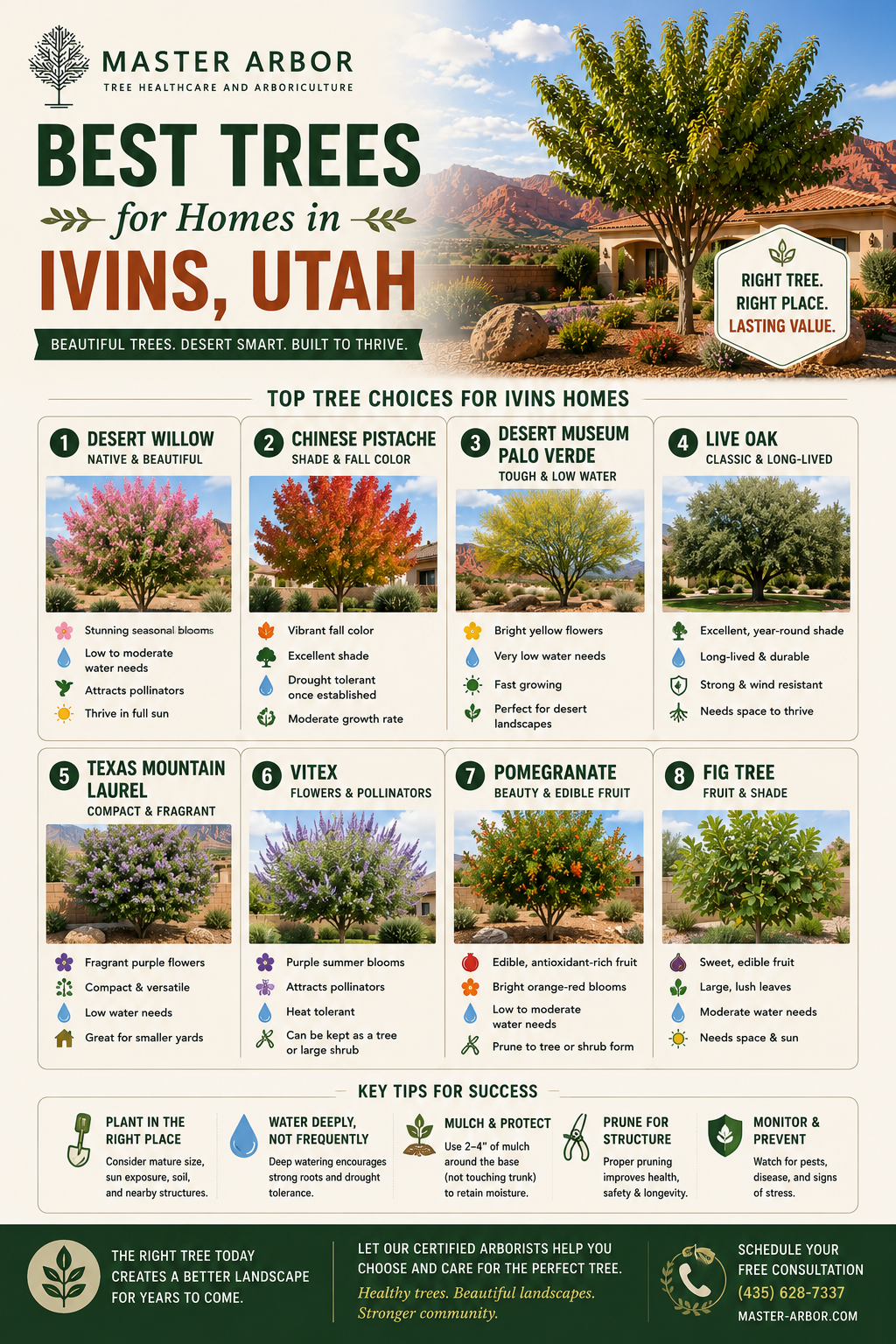
1. Desert Willow
Desert willow is one of the most natural choices for an Ivins landscape.
This Southwestern native produces trumpet-shaped flowers that can attract hummingbirds and other pollinators. It performs well in sunny locations and generally requires less water after establishment than many traditional ornamental trees.
Best qualities
Excellent heat tolerance
Colorful seasonal flowers
Low to moderate water needs after establishment
Attractive fit for desert and xeriscape designs
Relatively manageable mature size
Desert willow is a good choice for homeowners who want a flowering tree without creating a heavy, dense canopy.
2. Chinese Pistache
Chinese pistache is a popular option for homeowners who want meaningful shade and seasonal color.
Once established, it can tolerate heat and periods of dry weather better than many conventional shade trees. Its broad canopy makes it useful near patios, lawns, and outdoor gathering areas, provided it has enough room to mature.
Best qualities
Strong shade potential
Attractive fall color
Good heat tolerance
Useful as a front-yard or street tree
Moderate growth rate
Chinese pistache should be planted where its mature canopy and roots will have adequate space. Early structural pruning can also help it develop a stronger form.
3. Desert Museum Palo Verde
The Desert Museum palo verde is well suited to modern desert landscapes in Ivins.
Its green bark, airy canopy, and bright yellow flowers give it a distinctive Southwestern appearance. It is also highly drought tolerant once established.
Best qualities
Very low water needs after establishment
Bright yellow flowers
Fast growth
Light, filtered shade
Strong visual fit with red-rock landscapes
Because palo verde trees can develop long or uneven branches, proper placement and professional tree pruning southern utah are important for long-term structure.
4. Live Oak
For homeowners seeking a substantial, long-lived shade tree, certain live oaks may be worth considering.
Live oaks can provide dense shade and year-round foliage, but they need more space and thoughtful irrigation than smaller desert trees. They are generally better suited to larger lots where their roots and canopy will not be crowded.
Best qualities
Excellent shade
Evergreen or nearly evergreen appearance
Strong visual presence
Long-term landscape value
Useful for larger properties
An arborist can help determine whether a live oak is suitable for your soil, available space, and watering setup.
5. Texas Mountain Laurel
Texas mountain laurel is a smaller evergreen tree or large shrub that works well in water-conscious landscapes.
It produces clusters of fragrant purple flowers and has dense, dark-green foliage. Its compact size makes it useful near courtyards, entryways, and smaller homesites.
Best qualities
Evergreen foliage
Fragrant spring flowers
Compact size
Low water use after establishment
Good fit for smaller spaces
This is a strong option when a full-sized shade tree would overwhelm the planting area.
6. Vitex or Chaste Tree
Vitex is another flowering option that can perform well in warm, sunny conditions.
Its purple flower spikes attract pollinators and add color during the growing season. It can be maintained as a multi-stemmed tree or large shrub.
Best qualities
Heat tolerant
Attractive purple flowers
Pollinator friendly
Moderate water needs
Adaptable growth habit
Routine pruning may be needed to maintain its desired size and structure.
7. Pomegranate
Pomegranate can provide both ornamental value and edible fruit.
Its bright flowers, glossy foliage, and fruit make it a useful addition to backyard gardens and edible landscapes. It naturally grows as a shrub but can be trained into a small tree.
Best qualities
Well suited to hot climates
Edible fruit
Attractive flowers
Moderate size
Useful for edible landscapes
Homeowners should be prepared for seasonal fruit cleanup and regular pruning if they want a defined tree form.
8. Fig Tree
Figs often perform well in warm Southern Utah landscapes when they receive appropriate irrigation and enough room.
They provide large leaves, seasonal fruit, and a dense canopy. However, they should not be planted too close to foundations, walls, or hardscape.
Best qualities
Edible fruit
Broad foliage
Fast establishment in suitable conditions
Productive backyard tree
Good summer screening
Before planting, consider the mature width and the amount of fruit cleanup the location can accommodate.
Trees That Often Struggle in Ivins
Some trees may survive in Ivins but require more water, protection, or ongoing care than they are worth.
Homeowners should think carefully before planting trees such as:
Aspen
Birch
Sugar maple
Dogwood
Blue spruce
Other species adapted to cool or moist climates
These trees frequently struggle with intense heat, low humidity, alkaline soil, and reflected sun. Chronic stress can lead to yellow leaves, leaf scorch, sparse growth, and increased vulnerability to pests.
Give New Trees the Best Start
Even desert-adapted trees need careful attention after planting.
During establishment:
Water the root ball and surrounding soil consistently.
Gradually expand the watering area as roots grow.
Apply two to four inches of mulch without piling it against the trunk.
Protect thin bark from sun scald.
Avoid heavy pruning immediately after planting.
Inspect regularly for insects and transplant stress.
Newly planted trees may need more frequent monitoring during their first Southern Utah summer. Our guide on how often to water new trees in Southern Utah offers additional establishment tips.
Watch for Insects and Stress
Heat-stressed trees are more vulnerable to aphids, spider mites, scale insects, and borers.
Signs of trouble may include:
Yellow or distorted leaves
Sticky residue
Fine webbing
Bumps on branches
Bark holes
Premature leaf drop
Professional tree insect prevention southern utah can help identify the pest and determine whether treatment is necessary.
Why Ivins Homeowners Choose Master Arbor
Master Arbor understands that tree recommendations must be based on more than a national planting list.
We consider:
Southern Utah’s heat
Ivins’ red-rock surroundings
Local soil conditions
Water availability
Property size
Mature tree dimensions
Long-term maintenance needs
Our goal is to help homeowners choose trees that enhance their property without creating unnecessary water use, structural conflicts, or maintenance problems later.
Choose the Right Tree Before You Plant
A tree may remain on your property for decades. Choosing carefully now can prevent expensive removals, damaged hardscape, excessive pruning, and disappointing growth in the future.
Master Arbor can help you evaluate your planting area and select a tree suited to your goals and Ivins’ desert climate.
Schedule a Tree Selection or Health Consultation
Master Arbor provides:
Tree-selection guidance
Site evaluations
Planting recommendations
Young-tree care
Professional pruning
Watering guidance
Insect prevention
Long-term tree-health planning
Contact Master Arbor today to schedule a consultation for your Ivins property.
Frequently Asked Questions
-
Chinese pistache and appropriately selected live oaks can provide substantial shade when planted in locations with enough room for their mature canopies and roots.
-
Desert willow and Desert Museum palo verde are strong low-water choices once established. The best option depends on the available space, desired shade, and landscape style.
-
Yes. Pomegranate and fig trees can perform well in Ivins with proper placement, irrigation, pruning, and seasonal maintenance.
-
New trees require more frequent watering while their roots establish. The exact schedule depends on the season, species, root-ball size, soil drainage, and irrigation method. Check soil moisture rather than relying only on a fixed calendar.
-
An arborist can help evaluate mature size, soil, irrigation, sun exposure, and nearby structures so the tree is less likely to cause problems or struggle as it grows.
Related Articles
Continue learning with these helpful resources:
Why Are My Tree Leaves Turning Yellow? 10 Common Causes in Southern Utah
Monsoon Season Tree Safety: Preparing for High Winds & Storm Damage
Find Your Perfect Tree: The Southern Utah Homeowner's Comparison Guide
